Henry VI
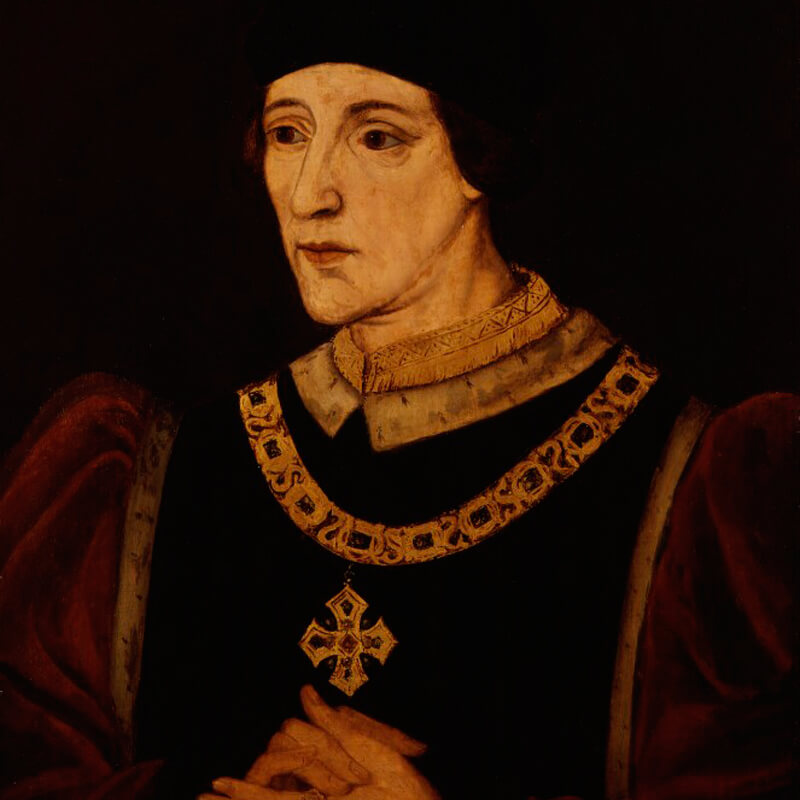
Henry VI was King of England from 1422 to 1461 and again from 1470 to 1471. He was also the King of France from 1422 to 1453, and the only English monarch to have been crowned King of France. He succeeded to the thrones of England and France before the age of one, when his father Henry V of England and his grandfather Charles VI of France died within months of one another. He was a pious and studious recluse whose incapacity for government was one of the causes of the Wars of the Roses, which dominated his reign.
Quick
Facts.
- Born: 1421
- Died: 1471
- Reign: 1422 - 1461 & 1470 - 1471
- House: House of Plantagenet
- Predecessor: Henry V
- Successor: Edward IV
Henry VI was a contrasting figure to his father Henry V, they were complete opposites in every way. Henry VI was set to govern through a turbulent period, characterised by losing power in France and the ultimate descent into crisis culminating in the long-running dynastic dispute known as the Wars of the Roses. His was a reign with bouts of insanity and warfare between rival branches of the royal family. He was overthrown, restored, and finally murdered.
The Child King
Henry VI was born in December 1421 at Windsor Castle during the Hundred Years’ War. He was the only child of the charismatic warrior king Henry V and Catherine of Valois. He became King of England in September 1422 at just nine months old, on the death of his father. By October of the same year, he became King of France on the death of his maternal grandfather Charles VI. Because of his father’s success in the Hundred Years’ War, Henry V left England with a lot of land in France.
Henry was eventually crowned King of England in 1429 at Westminster Abbey aged seven, and in 1431 he was crowed King of France as Henry II at Notre Dame in Paris just after his ninth birthday; the only English monarch to have been crowned King of France.
Since Henry was too young to rule personally, his uncles were nominated as regents of England and France, and a council was set up to govern in the King’s name. His eldest uncle, John, Duke of Bedford, was appointed Regent of France, and in England, the country was ruled by a council of which his younger uncle, Humphrey, Duke of Gloucester was the chief member as ‘Protector and Defender of the Realm’.
The Loss of French Lands
Whilst Henry was still a child and England was ruled by a regency government, most of the French land his father gained was lost by the time Henry was declared mature enough to rule due to diplomatic mistakes and military failures. Some of these failures included the famous English defeat at Orléans in 1429 by the French army led by Joan of Arc, and the rival crowning of the French Dauphin as Charles VII. Charles VII succeeded, with the aid of Joan of Arc in driving the English from French soil and in solidifying the administration of the French monarchy.
The dual monarchy proved too difficult for the king and England to maintain, and the successes of the Dauphin and Joan of Arc began to weaken England’s grip on its French possessions. To make things worse, when Henry’s uncle John, Duke of Bedford, who was appointed Regent of France, died in 1435, his death, combined with Burgundy breaking the alliance with England, led to the collapse of English rule in northern France.
A Weak King and Power-hungry Nobles
As well as the military setbacks in France, the political and financial crises in England began to create divisions among the nobility in Henry’s government.
Henry’s minority was never officially ended, but from 1437 he was considered old enough to rule for himself. When he finally became King, power-hungry nobles were keen to hold on to the control they had had during his childhood. Eventually, they sought to manipulate him for their own benefit.
Henry VI undoubtedly stood in the shadow of his father, whom he’d never met. Henry V’s illustrious victories over the French in the Hundred Years’ War, most notably the Battle of Agincourt, were still fresh in popular memory at the time of his son’s accession. Henry didn’t possess his father’s imposing figure, his physical demonstrations of royal power and authority in battle, nor did he excel in any physical capacity. Instead, Henry was concerned to protect the church and achieve international peace. He was described as timid, shy and passive, and known for his piety, generosity and avoidance of violence; not the usual qualities of a king of that time.
Henry entrusted the power of his court to a few greedy power-grabbing noblemen who were called his “favourites”. His closest companion was the steward of his household, William de la Pole, Earl of Suffolk, who governed the country in a disorderly and chaotic way. It soon became clear Henry differed quite dramatically from his father; seen as weak, with an inability to gain any kind of control over his court, and a desire to avoid conflict.
Bad Decisions
In the 1440s Henry became concerned only with religious observances and the planning of his educational foundations of Eton College and King’s College in Cambridge. Although royal finances were in a parlous state, Henry spent lavishly on his religious and educational foundations.
As a way to find peace with France, William de la Pole, Earl of Suffolk advised Henry to make a truce via marriage. A truce was made in 1445 where Henry married Margaret of Anjou, a niece of King Charles VII of France, who was single-minded and had a forceful personality, becoming his powerful but disruptive queen and a leader of the Lancastrian army in the Wars of the Roses. However, as part of the deal, Henry had to give away more of his French lands including Maine and Anjou.
Despite the marriage and the very unpopular decision to surrender control of Maine, the peace policy failed and war with France resumed in 1449, with France rapidly recovering much of the territory held by the English, including their ancestral lands in Aquitaine, and then in 1450 Normandy was also lost.
Henry’s lack of interest in politics, picking the wrong advisers, his failures and lost lands in France and domestic unrest, encouraged factionalism, and power struggles began to develop at court. Politics were dominated by the rivalries of a series of powerful nobles including William de la Pole, Earl of Suffolk, Humphrey, Duke of Gloucester, and Henry, Cardinal Beaufort.
William de la Pole was blamed for the financial disaster, the ill advised marriage, the loss of Maine and for the failure of policy in France leading to the loss of Normandy, and he was subsequently impeached in 1450. Henry tried to protect him, refusing to make a decision on the charges, but he was banished for five years. However, he was captured and executed, which provoked a major rebellion, and factions and favourites encouraged the rise of further disorder in the country.
A Power Struggle
After the fall of William de la Pole, the contenders for power were the Lancastrian Edmund Beaufort, Duke of Somerset, and Richard, Duke of York. Richard was a descendant of Edward III and a cousin of Henry’s whose claim to the throne, by strict primogeniture, was better than Henry’s. The Duke of Somerset and the Duke of York didn’t like each other. Somerset became Henry’s closest councillor and Henry repeatedly rejected the Duke of York’s attempts to oust him. Those who supported the Duke of York’s challenge to the crown became known as Yorkists, whilst the King, his queen Margaret and their noble supporters became known as the Lancastrians.
Henry’s powerful relatives were eager to grasp power and place themselves at the head of factions in the state, and the council soon became their battleground. As the friction was escalating, with the divisions becoming more visible and rival groups warring between themselves, Margaret of Anjou consolidated her power as she and her supporters in court were growing more powerful whilst Henry withdrew and languished in the shadows. Henry was soon faced by accusations of mismanagement in government and wartime misconduct. This indictment came from none other than Henry VI’s cousin, Richard, Duke of York.
Henry’s Downfall
In 1453 Margaret gave birth to a boy named Edward of Westminster (also known as Edward of Lancaster), their only child. However, in the same year, news arrived of a catastrophic defeat in Gascony which had been in the hands of the English for centuries. The losses in France and the challenges to his rule led Henry to suffer a series of mental breakdowns and severe depression. Henry collapsed mentally and physically, unable to speak or feed himself, let alone respond to the birth of his son.
As Henry looked increasingly unstable, power struggles loomed between Edmund Beaufort, Duke of Somerset and Richard, Duke of York. Somerset was a close personal friend and ally of Margaret of Anjou and his rivalry with Richard would soon escalate into war. Meanwhile, another powerful noble, Richard Neville, Earl of Warwick would become instrumental. Known as “the kingmaker”, his grievances with Somerset would lead to his support for the Duke of York, although his loyalty and support swayed between both camps at various times.
Mounting Tensions
Henry was unable to rule, and in 1454 after months of crisis, the Duke of York became Protector of the Realm. Tensions mounted between Margaret and York over control of the incapacitated King’s government, which developed into a major dispute over the succession to the English throne. Additionally, the Duke of York and the Duke of Somerset developed a fierce political rivalry and jostled for power. York used his position to purge the Lancastrian supporters in court and threw Somerset into the Tower of London. This action created deep animosity, and when Henry temporarily recovered in 1455, York was dismissed from his role and Somerset was released and restored to power.
The Yorkists and Lancastrians began to prepare for battle, recruiting soldiers and making preparations for war, with supporters choosing either a Red Rose to represent the House of Lancaster or a White Rose for the House of York, leading to a long period of dynastic conflict known as the Wars of the Roses.
The Wars of the Roses Begins
The Lancastrians were back in power, and when York and his closest allies, the earls of Salisbury and Warwick, were excluded from a Great Council summoned in April 1455, this proved the trigger for the first battle of the Wars of the Roses, at St Albans on 22nd May 1455. Henry didn’t participate in the fighting but was wounded in the neck. Somerset was killed and York essentially took control of the government, briefly becoming Protector again, but he was unable to command sufficient support among the nobility.
For the rest of his reign, Henry’s queen, Margaret of Anjou, was determined to fight for the Lancastrian cause of her husband and son rather than negotiate a compromise with the Yorkists. Richard, Duke of York, asserted his legitimate claim to the throne as he was descended, through his mother, from Edward III‘s second surviving son Lionel, Duke of Clarence. Henry was descended from Edward’s third surviving son John of Gaunt, Duke of Lancaster. The Wars of the Roses were therefore a struggle to decide if the succession should keep to the male line or could pass through females.
After five years of civil war between the Lancastrian and Yorkist factions, with a great loss of life on both sides, Henry VI was captured at the Battle of Northampton in July 1460 and imprisoned in the Tower of London, and Queen Margaret fled to Wales. Now a prisoner, Henry was effectively their puppet king, and in October 1460 he was forced to accept the Act of Accord which disinherited his own son in favour of the Duke of York.
Shortly after in December 1460, Richard, Duke of York was killed at the Battle of Wakefield, but his son Edward, Earl of March, who was an able commander, took up the fight. Now Edward was the leader of the Yorkist forces and he was after both the throne and revenge for his father’s death.
Henry is Deposed
Henry VI was rescued after the Lancastrian victory at the Second Battle of St Albans in February 1461. However, York’s son and heir, Edward, defeated the Lancastrians at the Battle of Towton in the following month, Henry was deposed and Edward took the throne as King Edward IV. There were now effectively two monarchs co-existing, but whilst London opened its gates to the Yorkist forces, Henry, Margaret and their son Edward fled to Scotland.
Henry and his family returned to England in 1464 to support an unsuccessful Lancastrian rising, but Henry was captured by Edward’s forces in 1465 and imprisoned once again in the Tower of London. However, a quarrel between Edward IV and the powerful “kingmaker” Richard Neville, Earl of Warwick, led Warwick to switch sides, and in 1470 an alliance was made between Warwick and Queen Margaret. They restored Henry to the throne and Edward fled abroad.
The Death of Henry VI
Henry’s restoration was brief, as Edward returned from exile the following year and retook power. Warwick the Kingmaker was killed at the Battle of Barnet on 14th April 1471, and one month later Edward destroyed the Lancastrian forces at the Battle of Tewkesbury, where Henry and Margaret’s only son was among the Lancastrian dead. Queen Margaret was captured and Henry was imprisoned in the Tower of London once again, but was murdered soon afterwards, possibly killed on the orders of King Edward IV, who remained king of England until his death in 1483.
Henry VI was buried at Chertsey Abbey before being moved to St George’s Chapel in Windsor Castle by Richard III in 1484, where Edward IV was buried. Miracles were allegedly witnessed at his tomb at Chertsey and he was regarded by some as a saint and martyr. Margaret of Anjou remained a prisoner until ransomed by the French King, Louis XI, in 1475. Back in France, no longer the force she once was, she was denied her personal lands and received only a modest pension before she died in 1482.
Henry VI’s Legacy
Although Henry VI was a weak and ineffectual king, he was intelligent and generous, remembered for his promotion of religion and learning. He left a legacy of educational institutions, having founded Eton College and King’s College in Cambridge, and All Souls College in Oxford. He remains England’s youngest ever monarch and the only English king to be crowned King of France; an impressive, and perhaps daunting accolade for someone aged just nine years old at the time.
However, he was raised under both the shadow of his own impending reign and the illustrious legacy of his father. He suffered with debilitating mental illness and was deposed twice during his reign before he was killed for his throne, making him the last Lancastrian ruler of England. Under his reign, England’s prized possessions and territories in France were lost and the English found themselves at a crossroads both politically and militarily, resulting in the civil wars known as the Wars of the Roses which dominated his reign. The wars would rage on long after Henry VI’s death, only reaching its conclusion with the union of the warring houses of York and Lancaster, ushering in a new dynasty: the Tudors.
Did you enjoy this post?
I hope you found this post useful. I put a great deal of time and effort in to building, maintaining and populating the website. If you like, you could say a small thank you by buying me a coffee. You don't have to, but it would be nice :)
Buy me a coffee
Stay up to Date
Follow me on my journey and get notified whenever a new post is published by following Kings & Castles on Facebook.
Follow MeExplore The Map
Discover the hundreds of castles, churches, monasteries, cathedrals and other historic locations that I've personally visited across England and Wales. Search by location, explore nearby sites and plan your next historical adventure.
Share: