Henry V
Henry V, also known as Henry of Monmouth, was King of England from 1413 until his death in 1422. He was the son of Henry IV and the second Lancastrian king of England. Henry V was stern, ruthless, and a brilliant general; he was one of the great warrior kings of medieval England. Despite his relatively short reign, his famous victory against the French at the Battle of Agincourt during the Hundred Years’ War made England one of the most powerful kingdoms in Europe.
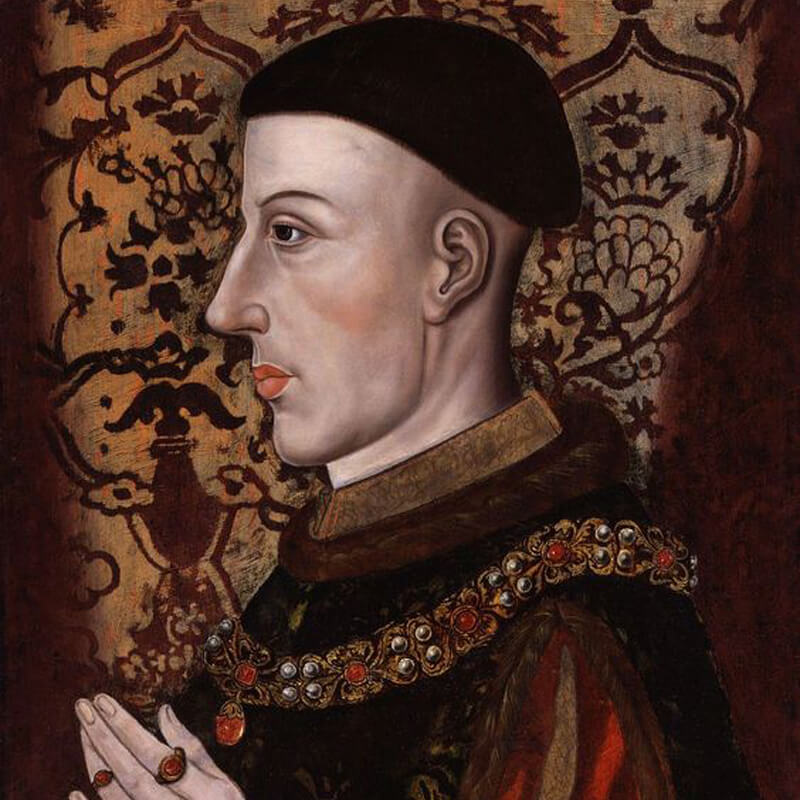
Quick
Facts.
- Born: 1386
- Died: 1422
- Reign: 1413 - 1422
- House: House of Plantagenet
- Predecessor: Henry IV
- Successor: Henry VI
Henry of Monmouth was born in 1386 (possibly 1387) at Monmouth Castle in Monmouth, Monmouthshire, Wales. He was the son of Henry Bolingbroke, later King Henry IV, and his wife Mary de Bohun. From the house of Lancaster, Henry’s lineage was impressive with notable ancestors such as John of Gaunt and King Edward III. Henry became heir apparent and was given the title Prince of Wales at his father’s coronation after he seized the throne in 1399, and soon after he was bestowed more titles including Duke of Aquitaine and Duke of Lancaster.
He showed his military abilities as a teenager, joining his father in battles, playing a central part in the Battle of Shrewsbury in 1403 where Henry narrowly escaped death when an arrow struck him in the face, leaving him with a permanent scar. The battle was an English victory, defeating a rebel army led by Henry “Harry Hotspur” Percy. He also successfully fought against rebellions in Wales, led by the self proclaimed Welsh Prince, Owain Glyndŵr. Henry’s appetite for military engagement was equally matched by his desire to involve himself in government, where he played an important role in the governing of the country when his father’s health was declining, until his death in 1413.
Upon his father’s death in 1413, Henry ascended to the throne of England as Henry V, and revived the historic English claim to the French throne. Although his father was unpopular because he was a usurper and not the rightful king, Henry V became greatly favoured by his people. Laying claim to the French crown and aiming to regain lost lands from his ancestors, Henry set sail for France in 1415, which would be the focus of his attention for the rest of his reign.
Strongly motivated, Henry V found himself embroiled in the Hundred Years’ War between England and France which had been escalating since 1337, which began with his great-grandfather, Edward III.
Henry’s first victory was the capture of the port of Harfleur, gaining Henry a strategic victory. However, after his victory, Henry’s army was struck down by dysentery, leading to around one third of his men dying from the disease, leaving Henry with greatly reduced numbers. Henry and his remaining forces attempted to withdraw to English-held Calais but found their path blocked by a considerably larger French army. Henry offered the French Dauphin to personal combat but was refused, forcing him into battle.
On 25th October 1415, the day of Saint Crispin, a feast day, Henry led his diminished men against the imposing French army and engaged in the famous Battle of Agincourt. It is estimated that the French had around 50,000 men compared to England’s 5,000 men. The idea of an English victory looked impossible, but Henry’s genius and strategical experience would gain them their impossible victory.
Henry used the battlefield at its narrowest point, preventing the significantly larger French army from surrounding them. Henry’s archers, which made up nearly 80 per cent of his army, made use of the English longbow and launched their arrows in a series of volleys. The French, forced to charged towards them through the slippery mud, were met by a hail of arrows and a row of stakes reaching six feet tall, forcing them to retreat.
Despite the superior numerical disadvantage, thanks to Henry’s strategy the battle ended in an overwhelming victory for the English. The unexpected victory boosted English morale and prestige, crippled France, and started a new period of English dominance in the war. Henry returned to England triumphant, welcomed in the streets by his people who held him in the highest possible regard as their warrior king.
Henry soon afterwards returned to France and built on his military success with his conquest of most of northern France, including the formerly English-held Duchy of Normandy. The French were forced to agree to the Treaty of Troyes in 1420, which was an agreement that King Henry V of England and his heirs would inherit the French throne upon the death of King Charles VI of France. This major success further solidified his position and the love of his people back in England.
Also in 1420, Henry married Catherine of Valois, the daughter of the French king. Henry returned with his wife to England later in the same year, went on a royal progress around the country, and Catherine was crowned Queen at Westminster Abbey in February 1421.
Now at the height of his power, Henry returned to France once again to continue with his military campaigns, despite the fact that Catherine was now heavily pregnant with his child. In December 1421 Catherine gave birth to their only child; Henry’s son and heir, the infant Henry VI. Tragically, the king would never get to meet his son. Henry’s triumph was short-lived, as his health started to deteriorate whilst campaigning in France, until he died suddenly, probably of dysentery, in August 1422.
Henry V was succeeded by his nine-month-old son, who was crowned Henry VI of England and Henry II in France. Unfortunately, his son’s reign would be a disaster. He was the complete opposite of his father; shy, timid and prone to mental breakdowns. Henry VI would go on to lose all the French lands won by his father and find himself at the centre of the Wars of the Roses, turning England into a chaotic nation.
Henry V had the capacity to inspire devotion in others and possessed high qualities of leadership, resulting in the largest holding of French territory by an English king since the Angevin Empire. Henry’s victory at the Battle of Agincourt is one of England’s most celebrated victories and was one of the most important English triumphs in the Hundred Years’ War. He defined the country with his military prowess, making an impact so distinct that Shakespeare himself memorialised him in literature. King Henry V was a warrior king and a shining example of medieval kingship.
Did you enjoy this post?
I hope you found this post useful. I put a great deal of time and effort in to building, maintaining and populating the website. If you like, you could say a small thank you by buying me a coffee. You don't have to, but it would be nice :)
Buy me a coffee
Stay up to Date
Follow me on my journey and get notified whenever a new post is published by following Kings & Castles on Facebook.
Follow MeExplore The Map
Discover the hundreds of castles, churches, monasteries, cathedrals and other historic locations that I've personally visited across England and Wales. Search by location, explore nearby sites and plan your next historical adventure.
Share: