Vortigern
Vortigern is one of the most mysterious figures in early British history. He is traditionally described as a powerful British ruler who lived during the 5th century, during the turbulent period following the withdrawal of Roman authority from Britain. His story is closely connected with the arrival of the Anglo-Saxons and the legendary wizard Merlin.
The name Vortigern may come from a Brittonic title meaning something like “Great Lord” or “Supreme Leader”. It is therefore possible that Vortigern was not originally a personal name but a title used by a powerful ruler. Medieval writers, however, treated Vortigern as the name of a particular king.
Vortigern’s story is most famously told by the 9th-century Welsh monk and historian, Nennius, in the Historia Brittonum. According to this account, Vortigern faced serious threats from the Picts and Scots. To strengthen Britain’s defences, Vortigern invited Germanic mercenaries, particularly the Saxons Hengist and Horsa, to settle in Britain and fight on his behalf.
The decision was supposedly disastrous. The Saxons gained increasing power and demanded more land and payment. According to legend, Vortigern agreed to give them the Isle of Thanet in Kent. Their numbers and influence eventually grew, leading to conflict between the Britons and the newcomers. The traditional story therefore presents Vortigern as a ruler whose attempt to protect Britain unintentionally helped create the conditions for the Anglo-Saxon settlement of England.
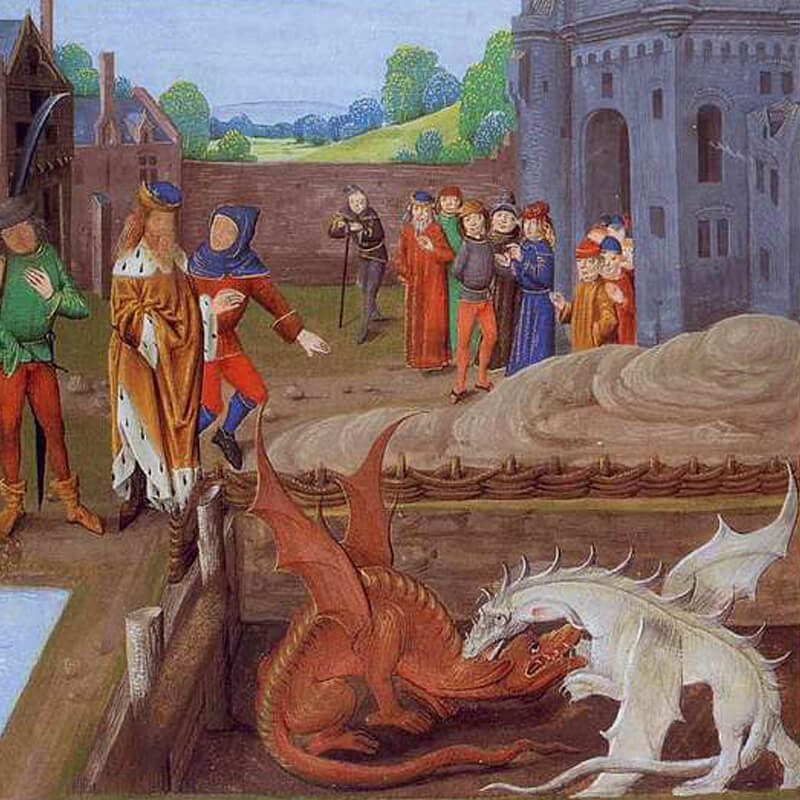
Vortigern is also strongly associated with the legendary figure of Merlin. In Geoffrey of Monmouth‘s Historia Regum Britanniae, written in the 12th century, Vortigern attempts to build a fortress but its foundations repeatedly collapse. His advisers tell him that the structure can only stand if the blood of a fatherless boy is mixed with the foundations. The boy is Merlin, who reveals that two dragons are fighting beneath the site. A red dragon represents the Britons, while a white dragon represents the Saxons. This famous story became an important part of British Arthurian legend.
Geoffrey’s account also portrays Vortigern as a morally flawed ruler who takes control of Britain through questionable means and becomes involved with Hengist’s family. Much of this material is considered legendary rather than reliable history.
The historical Vortigern, if he existed as described, probably lived during a period of enormous change. Roman rule had ended, and Britain was divided among competing local rulers. Archaeological evidence confirms that Germanic peoples settled in parts of Britain during the 5th century, but it cannot prove that Vortigern personally invited them or that he was responsible for their arrival.
Vortigern’s importance therefore lies partly in the uncertainty surrounding him. He stands between history and legend, representing the difficult transition from Roman Britain to Anglo-Saxon England. Whether he was a single historical ruler, a title applied to several leaders, or a figure later embellished by medieval writers, his story has had a lasting influence on British historical tradition and Arthurian legend.
Did you enjoy this post?
I hope you found this post useful. I put a great deal of time and effort in to building, maintaining and populating the website. If you like, you could say a small thank you by buying me a coffee. You don't have to, but it would be nice :)
Buy me a coffee
Stay up to Date
Follow me on my journey and get notified whenever a new post is published by following Kings & Castles on Facebook.
Follow MeExplore The Map
Discover the hundreds of castles, churches, monasteries, cathedrals and other historic locations that I've personally visited across England and Wales. Search by location, explore nearby sites and plan your next historical adventure.
Share: