Geoffrey Chaucer and The Canterbury Tales
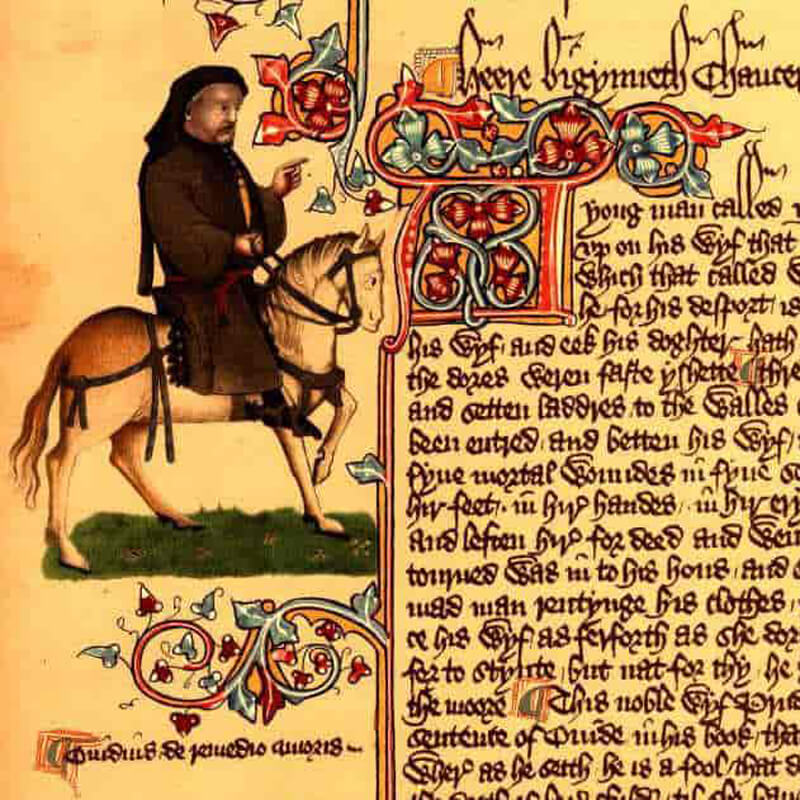
Geoffrey Chaucer is widely regarded as one of the greatest English writers of the Middle Ages. He lived during a period of significant political, social and economic change, including the Black Death, the Hundred Years’ War, and growing tensions between different social classes. His most famous work, The Canterbury Tales, provides a vivid picture of medieval English society.
Chaucer was born c. 1343 in London into a prosperous merchant family. He served at the royal court and worked as a diplomat, civil servant and administrator. His travels to France and Italy introduced him to European literature and influenced his own writing. He became particularly interested in writers such as Dante, Petrarch and Boccaccio.
Chaucer began writing The Canterbury Tales during the late-14th century. The work is presented as a collection of stories told by a group of pilgrims travelling from London to Canterbury Cathedral, where they intend to visit the shrine of St Thomas Becket. The pilgrimage provides Chaucer with a reason to bring together people from many different backgrounds.
The group includes a Knight, Miller, Reeve, Cook, Wife of Bath, Merchant, Clerk, Franklin, Pardoner and Parson, among others. Each character represents a different part of medieval society. Chaucer uses their appearance, behaviour and stories to reveal their personalities and social positions.
One of the most remarkable features of The Canterbury Tales is its variety. The stories include romance, comedy, morality tales, adventure and satire. The characters often tell stories that reflect their own personalities or disagreements with other pilgrims. For example, the Wife of Bath speaks confidently about marriage and women’s independence, while the Pardoner openly admits his greed despite preaching against the very sins he practises.
Chaucer’s work is also important because he wrote largely in Middle English, the language spoken by many people in England at the time. Although educated writers frequently used Latin or French, Chaucer demonstrated that English could be used to create sophisticated and influential literature. His writing helped establish English as an important literary language.
The Canterbury Tales is also valuable as a source of information about medieval life. Chaucer describes occupations, clothing, religious beliefs, marriage, money and social relationships. His characters are not presented simply as heroes or villains. Instead, they often possess a mixture of good and bad qualities, making them surprisingly realistic.
Satire is another important element of the work. Chaucer gently, and sometimes sharply, criticises corruption, hypocrisy and greed, particularly among members of the Church and other powerful groups. However, he also makes fun of ordinary people and their weaknesses.
Chaucer died in 1400 before completing The Canterbury Tales. His original plan appears to have involved many more stories than the collection ultimately contained. Nevertheless, the surviving tales became one of the most important works in English literature.
Geoffrey Chaucer’s great achievement was his ability to combine humour, social observation and storytelling. Through the pilgrims and their tales, he created a fascinating portrait of medieval England. More than six centuries later, The Canterbury Tales remains important because its themes – love, greed, ambition, hypocrisy, marriage and human nature, are still recognisable to modern readers.
Did you enjoy this post?
I hope you found this post useful. I put a great deal of time and effort in to building, maintaining and populating the website. If you like, you could say a small thank you by buying me a coffee. You don't have to, but it would be nice :)
Buy me a coffee
Stay up to Date
Follow me on my journey and get notified whenever a new post is published by following Kings & Castles on Facebook.
Follow MeExplore The Map
Discover the hundreds of castles, churches, monasteries, cathedrals and other historic locations that I've personally visited across England and Wales. Search by location, explore nearby sites and plan your next historical adventure.
Share: