Henry IV
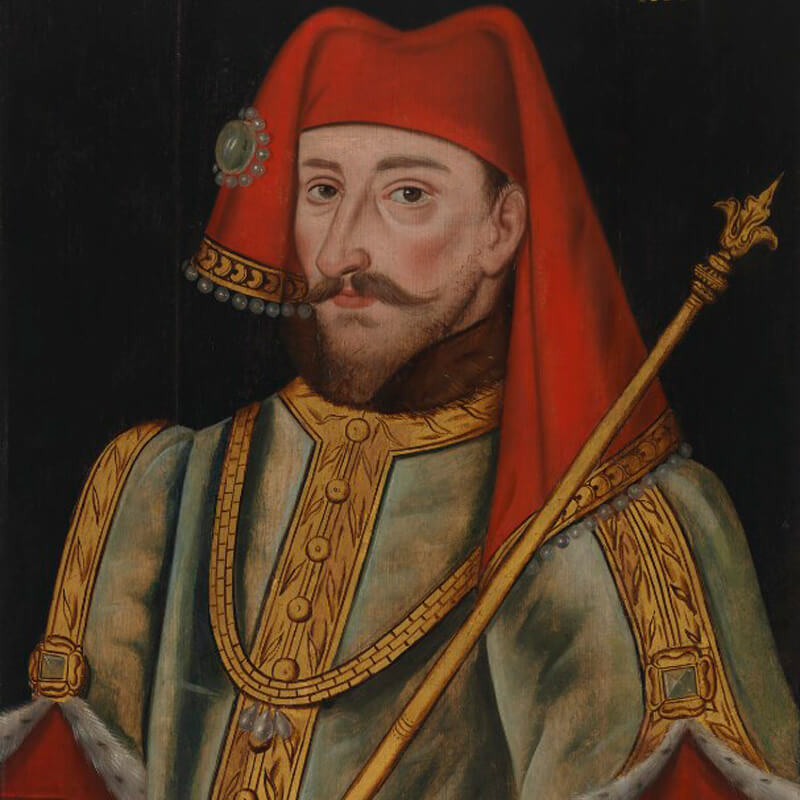
Henry IV, also known as Henry Bolingbroke, was King of England from 1399 until his death in 1413. Henry was the son of John of Gaunt, Duke of Lancaster, and a grandson of Edward III. He was exiled by his cousin King Richard II in 1398, but successfully took the throne by usurping his cousin the following year and became the first of three monarchs from the Plantagenet house of Lancaster. Henry IV was the first English ruler since the Norman Conquest whose mother tongue was English rather than French.
Quick
Facts.
- Born: 1367
- Died: 1413
- Reign: 1399 - 1413
- House: House of Plantagenet
- Predecessor: Richard II
- Successor: Henry V
Henry IV, also known as Henry Bolingbroke, was born in 1367 at Bolingbroke Castle, Lincolnshire, England. Henry was the eldest surviving son of John of Gaunt, Duke of Lancaster, by his first wife, Blanche of Lancaster, and a grandson of King Edward III.
In 1377 Henry’s cousin, Richard II became king. Henry and Richard were first cousins and childhood playmates, and they were admitted together as knights of the Order of the Garter in 1377.
During the early years of Richard II’s reign, Henry remained in the background while his father, John of Gaunt ran the government on the King’s behalf. His father managed to maintain his influence during the reign of his cousin, despite their fragile relationship.
Henry IV had six children from his first marriage to Mary de Bohun, while his second marriage to Joan of Navarre produced no surviving children.
In the late 1380s, Henry entered politics as an opponent of the crown by joining a group of opposition leaders called the Lords Appellants, who demanded reforms. In 1388, Henry and the other appellants launched a revolt against his cousin, the King, where some of the king’s closest friends and advisors were either executed or sent into exile, and the king was forced to accept their counsel.
In 1397 the King finally took his revenge on the appellants, many of whom were executed or exiled, and he seized their lands and goods. However, Henry and another young appellant, Thomas Mowbray, Duke of Norfolk were pardoned. But then in 1398, the two young former appellants accused each other of treason and a quarrel broke out between the two. The king ordered that the conflict be settled by a trial by combat, however Richard changed his mind at the last moment and instead decided to banish both Henry and Thomas Mowbray. He exiled Henry for 10 years, and Mowbray for life.
The House of Lancaster represented a real threat to Richard’s kingship, so when Henry’s father died in February 1399, Richard confiscated the vast Lancastrian estates, which should have passed to Henry. Disinherited and exiled, Henry was furious. Henry seized his opportunity and invaded England in June 1399 with a small force that quickly grew in numbers. Henry met very little opposition, as many were horrified by the king’s actions. He deposed Richard who surrendered without a fight, and had himself crowned King Henry IV in October 1399, claiming that Richard had abdicated of his own free will.
Henry gained the crown by usurpation and imprisoned Richard in Pontefract Castle, but risings in support of Richard led to his death. A group of Richard’s former courtiers, all now demoted from the ranks they had been given by Richard, plotted to murder the new king and restore Richard to the throne. This failed rebellion, known as the Epiphany Rising was crushed by Henry, but it highlighted the danger of allowing Richard to live. Richard II died shortly after in February 1400, imprisoned in Pontefract Castle, either by murder or by starvation, probably on Henry’s order.
Henry’s first task was to consolidate his position. He used his descent from King Edward III to justify his usurpation of the throne. However, he remained unrecognised as King by Charles VI of France, and his claim did not lead to general recognition.
Henry spent much of his reign fighting to keep control of his lands, defending himself against plots, rebellions, and assassination attempts, most of which were quashed easily. But the most serious revolt came in the form of Owain Glyndŵr, the last Welsh Prince of Wales, and the English knight Henry Percy, more famously known as Harry Hotspur.
Owain Glyndŵr was a prosperous man with several estates in Wales, and after some land disputes in 1400, it quickly escalated into a national uprising to overthrow the much resented English rule and to extend Welsh power. In 1403, Glyndŵr allied himself with Henry Percy, Earl of Northumberland, and his son Harry Hotspur. Hotspur was a renowned military figure known as “Hotspur” for his speed in advance and readiness to attack, who fought in several campaigns against the Scots and against the French during the Hundred Years’ War.
The Percy family were a very important family who had supported Henry in his efforts to overthrow Richard II, however their relationship soured when the family felt that they hadn’t been rewarded for their loyalty and services. Henry had promised many of the loyal families land, money and certain privileges in return for their support. Hotspur was in fact still awaiting payment for previously fighting against Owain Glyndŵr. As a result, the Percy family turned their backs on Henry and formed an alliance with their former enemy, the self-proclaimed Welsh Prince, Owain Glyndŵr.
The alliance between Glyndŵr and the Percys of Northumberland provided one of the toughest of Henry’s challenges. Nevertheless, Henry gathered an army and faced the rebels at the Battle of Shrewsbury in 1403, which ended with a royalist victory. The Percys were defeated, Harry Hotspur was killed, and his father, Henry Percy, the Earl of Northumberland, took refuge, first in Scotland and then in Wales. Henry’s eldest son, Henry of Monmouth, later King Henry V, was also fighting in the battle and was wounded by an arrow in his face, but he proved himself to be a great warrior, with his military ability contributing to the king’s victory.
Throughout the next several years the king had to deal with Scottish border raids and ongoing conflicts with the French, who aided the Welsh rebels in 1405–06. The Earl of Northumberland rebelled again in 1408, but it was quickly suppressed and the earl was killed in battle. This was the last armed challenge to Henry’s authority. In Wales, the English royalist forces eventually gained the upper hand and chipped away at Welsh resistance, culminating in the fall of Harlech Castle in 1409 and Owain Glyndŵr retreating to the Welsh mountains.
Henry had faced many challenges throughout his reign, and despite the successful defeat of rebellions and the crushing of plots against him, his continuous battle to remain on the throne began to take its toll. His reign was difficult, continually challenged and questioned. The later years of Henry’s reign were marked by serious health problems. He had a disfiguring skin disease and suffered several acute attacks of a grave illness over several years. As Henry’s health deteriorated, his eldest son and heir, Henry of Monmouth played a greater role in government until the death of his father.
In 1413 the first Lancastrian King, Henry IV, died weary and exhausted, and his son succeeded him as Henry V. His son would go on to be known to history as one of the great warrior kings of medieval England. However, the events surrounding Henry IV’s reign; a combination of Richard II’s misrule and tyranny, and the usurpation of the throne by Henry IV, would be responsible for the upcoming Wars of the Roses, involving his grandson, Henry VI and the house of Lancaster, and the opposing house of York.
Did you enjoy this post?
I hope you found this post useful. I put a great deal of time and effort in to building, maintaining and populating the website. If you like, you could say a small thank you by buying me a coffee. You don't have to, but it would be nice :)
Buy me a coffee
Stay up to Date
Follow me on my journey and get notified whenever a new post is published by following Kings & Castles on Facebook.
Follow MeExplore The Map
Discover the hundreds of castles, churches, monasteries, cathedrals and other historic locations that I've personally visited across England and Wales. Search by location, explore nearby sites and plan your next historical adventure.
Share: