Richard II
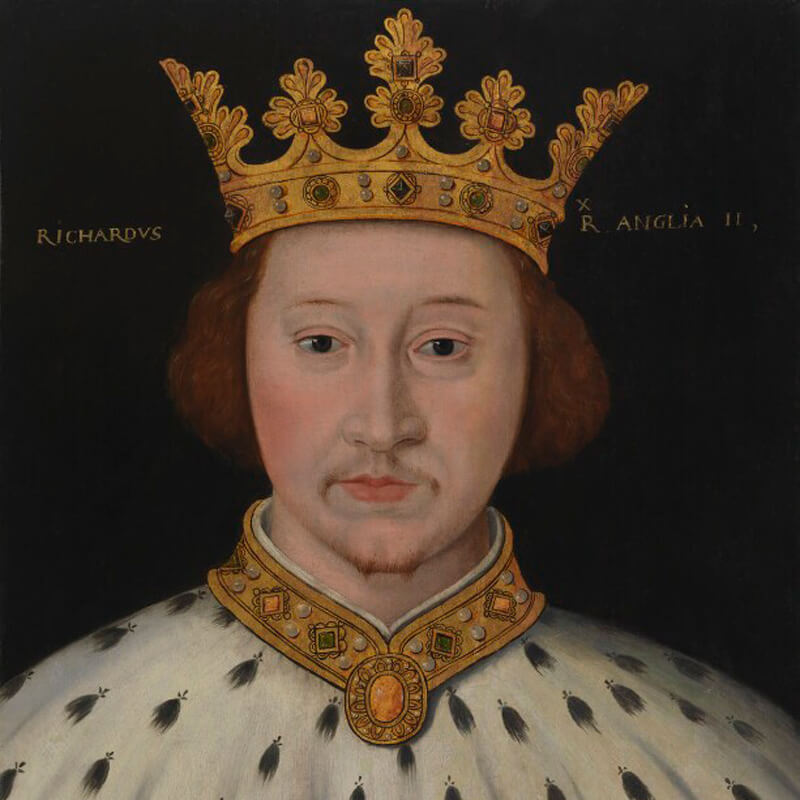
Richard II, also known as Richard of Bordeaux, was King of England from 1377 until he was deposed by his cousin Henry Bolingbroke (future Henry IV) in 1399, and murdered not long after. He was the son of Edward the Black Prince, Prince of Wales, and Joan of Kent. When Richard’s father died in 1376, he became heir to the English throne and succeeded his grandfather Edward III when he died the following year.
Quick
Facts.
- Born: 1367
- Died: 1400
- Reign: 1377 - 1399
- House: House of Plantagenet
- Predecessor: Edward III
- Successor: Henry IV
Richard of Bordeaux was born in 1367 in Bordeaux, the younger and only surviving son of Edward, the Black Prince, and his wife, Joan of Kent, and grandson of Edward III.
Richard’s father gained many military successes during the Hundred Years’ War, however in 1376 he succumbed to dysentery, leaving Richard as Edward III’s heir. At this time, the ageing King was in declining health and distanced himself from the daily strife of court and played a limited role in the government of the realm. Also at this time, England was losing the war with France, and England was in a volatile political and social situation.
Fearing that Richard’s uncle, the Duke of Lancaster, John of Gaunt would ascend the throne in place of the Black Prince, the English Parliament were quick to make arrangements to prevent it from happening by giving the princedom of Wales to Richard, also inheriting several of his father’s titles, ensuring that when the time came, Richard would become the next King of England.
When Edward III died in 1377, Richard succeeded to the throne aged just 10 years old, and became Richard II, King of England. However, Richard’s uncle, John of Gaunt, wielded most of the power and took a leading role in the ruling of the country, along with another of Richard’s uncles, Thomas of Woodstock, the Duke of Gloucester.
The first crisis of Richard’s reign was the Peasants’ Revolt of 1381. Still only a teenager, Richard found himself in the midst of a volatile political and social situation which he had inherited from his grandfather. The Black Death, the continued conflict with France and Scotland, the increasingly high taxes and the very unpopular poll tax all produced a great surge of grievances which inevitably caused social unrest, resulting in the Peasants’ Revolt, led by Wat Tyler.
One of the rebels first targets was John of Gaunt, who had his palace burnt to the ground. The Tower of London was sacked and the archbishop of Canterbury and the treasurer of England were murdered. However, Richard managed to successfully suppress the revolt. Famously, the young king bravely rode out to meet the rebels, winning them over with a speech and had them led out of London. He later had the leaders executed, then the uprisings in the rest of the country were defeated over the next few weeks, and the revolt was crushed.
Richard suppressed the revolt with an iron fist and won admiration for his bravery. His triumph boosted his own self-belief that he had the divine right to rule as king, but his absolutism conflicted with those in parliament.
In 1382 Richard married Anne of Bohemia, daughter of the Holy Roman Emperor, Charles IV. The marriage was a diplomatic one as Anne of Bohemia was a useful ally against France in the continuing conflict of the Hundred Years’ War. However, the marriage wasn’t well-received in England and failed to produce an heir, and she later died from the plague in 1394, which greatly affected Richard.
As Richard began to take control of government himself, he built a group of unpopular favourites. This caused discontent among the higher nobility and his relations with them were quickly deteriorating. In 1387 Richard was forced to accept a controlling council where control of government was taken over by a group of aristocrats known as the Lords Appellant. Made up of a group of lords hostile to Richard, and headed by the King’s uncle, Thomas of Woodstock, the Duke of Gloucester, they had their revenge on the king’s favourites in the ‘Merciless Parliament’ in 1388, where some of Richard’s closest friends and advisors were either executed or sent into exile, and Richard was forced to renew his coronation oath.
Richard bided his time, waiting for revenge, and would eventually reassert his position. But for the next eight years he governed in relative harmony with his former opponents, including his uncle John of Gaunt and the Lords Appellant, allowing for a peaceful transition to national stability.
Following the death of Richard’s wife, Anne of Bohemia in 1394, Richard and the king of France began peace negotiations in 1396, which led to a truce sealed at a meeting between Richard and Charles VI. To ensure peace between their countries, Richard married the six-year-old Isabella of Valois, eldest daughter of the French king.
In 1397 Richard finally took his revenge on the appellants, many of whom were executed or exiled, and he seized their lands and goods. Even his own uncle, Thomas of Woodstock, Duke of Gloucester, was arrested for treason by the king himself, imprisoned, and later murdered. Richard’s actions only exemplified his tyrannical image, and ultimately led to his downfall.
Richard’s cousin, Henry Bolingbroke (John of Gaunt’s son and future Henry IV) and Thomas Mowbray, Duke of Norfolk were two former appellants that had been pardoned, and were the only remaining appellants. In 1398 they accused each other of treason and a quarrel broke out between the two. The king ordered that the conflict be settled by a trial by combat, however Richard changed his mind at the last moment and instead decided to banish both men. He exiled his cousin Henry for 10 years, and Mowbray for life.
The House of Lancaster represented a real threat to Richard’s kingship, so when John of Gaunt died in February 1399, Richard confiscated the vast Lancastrian estates, which should have passed to his son Henry Bolingbroke. Henry, disinherited and exiled, was furious. Henry seized his opportunity and invaded England in June 1399 with a small force that quickly grew in numbers. Within a matter of months, he deposed Richard who surrendered without a fight, and had himself crowned King Henry IV.
Richard was imprisoned in Pontefract Castle, but risings in support of him led to his death. A group of Richard’s former courtiers, all now demoted from the ranks they had been given by Richard, plotted to murder the new king and restore Richard to the throne. This failed rebellion, known as the Epiphany Rising was crushed, but it highlighted the danger of allowing Richard to live. Richard II died imprisoned in Pontefract Castle in February 1400, either by murder or by starvation, probably on Henry’s order.
Early in Henry V‘s (son of Henry IV) reign, Richard II was given an honourable burial in the tomb that he had made for himself in Westminster Abbey.
Richard II was considered by many as a bad king who’s downfall was of his own doing. His later reign was increasingly controversial, particularly following his treatment of the Lords Appellant and his seizure of the Lancastrian inheritance, and it is widely accepted that Richard’s misrule, tyranny and his deposition are responsible for the 15th-century Wars of the Roses.
Did you enjoy this post?
I hope you found this post useful. I put a great deal of time and effort in to building, maintaining and populating the website. If you like, you could say a small thank you by buying me a coffee. You don't have to, but it would be nice :)
Buy me a coffee
Stay up to Date
Follow me on my journey and get notified whenever a new post is published by following Kings & Castles on Facebook.
Follow MeExplore The Map
Discover the hundreds of castles, churches, monasteries, cathedrals and other historic locations that I've personally visited across England and Wales. Search by location, explore nearby sites and plan your next historical adventure.
Share: