Henry VIII
Henry VIII was King of England from 1509 until his death in 1547. Henry is known for his six marriages, his efforts to have his first marriage to Catherine of Aragon annulled, divorcing two wives and having another two wives beheaded. His disagreement with the Pope over his annulment with his first wife led Henry to initiate the English Reformation, separating the Church of England from papal authority, leading to the establishment of the Protestant Church of England and the Dissolution of the Monasteries.
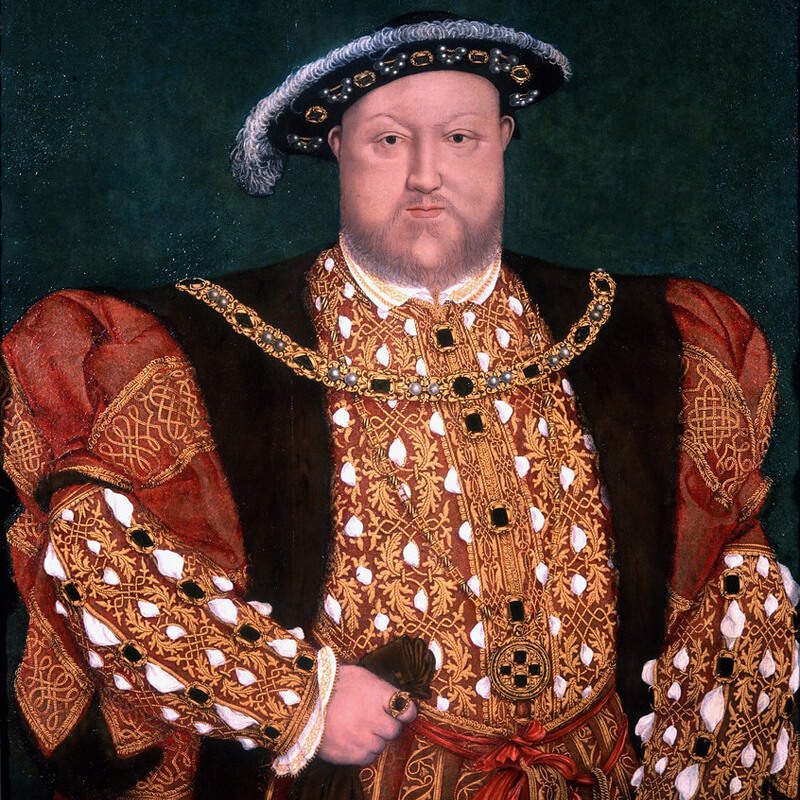
Quick
Facts.
- Born: 1491
- Died: 1547
- Reign: 1509 - 1547
- House: House of Tudor
- Predecessor: Henry VII
- Successor: Edward VI
Early Life
Henry VIII was born at Greenwich Palace in London on 28th June 1491. He was the second son of Henry Tudor (Henry VII) and Elizabeth of York. Henry was one of six children, only four of whom survived: Arthur, Margaret, Mary and Henry himself.
Henry’s father was the first ruler from the House of Tudor, after overthrowing Richard III when he defeated him at the Battle of Bosworth Field in 1485, bringing the Wars of the Roses to an end. He then married Elizabeth of York, the daughter of Edward IV and niece of Richard III, unifying the warring houses of Lancaster and York. Henry’s mother, Elizabeth of York, died on 11th February 1503, on her 37th birthday, just days after giving birth to a daughter, who also died shortly after being born.
Henry had his own servants and minstrels, including a fool named John Goose. He even had a whipping boy who was punished on Henry’s behalf whenever Henry did something wrong. It was common in England for young princes to grow up with whipping boys.
While his older brother Arthur was being prepared for the throne, Henry was steered toward a church career, with a broad education in theology, music, languages, poetry and sports. He was witty and highly educated, taught by private tutors for his entire upbringing. He loved music and even wrote some. He was a talented musician by the age of 10, and he could play many instruments, including the fife, harp, viola and drums. As the second son, Henry was supposed to become a high-ranking church official and his older brother was to ascend the throne as the king of England. In 1501 Arthur married Catherine of Aragon, a princess from Spain, but he died a few months later at Ludlow Castle in 1502 aged just 15 years old, likely from the sweating sickness.
King Henry VIII
On the death of his older brother, Henry became heir to the throne at the age of 10. When his father died in April 1509, Henry ascended the throne as King Henry VIII when he was 17 years old, becoming the second monarch in the Tudor Dynasty and inheriting a stable and peaceful realm without a breath of opposition, and his finances in a healthy surplus. He was given little training in preparation for his role as King by his father and therefore relied heavily on his counsellors in the early years of his reign.
As a young man and young king, Henry exuded a charismatic athleticism and diverse appetite for art, music and culture. He was also a lover of gambling and jousting, hosting countless tournaments and banquets. He could speak fluent Latin, French and Spanish, and was very religious. He was six feet tall, powerfully built, and a good athlete, huntsman, and dancer. Henry was also a talented author. His best-selling book refuting the heresies of Martin Luther and supporting the Roman Catholic church gained him the title ‘Fidei Defensor’ (Defender of the Faith) by Pope Leo X.
Henry was an active king ruling over a prosperous realm, and a leader in the English Renaissance. He made a significant investment in the Royal Navy (including the famous Mary Rose), massively increasing its size, and fought three wars with France. Henry ruled with an iron fist and his court soon learned to bow to his every wish.
Henry VIII would become most famous for three things; the English Protestant Reformation, the Dissolution of the Monasteries, and most famously, his six wives. The six wives of Henry VIII have become defined by the way their lives ended. The old English nursery rhyme ‘Divorced, Beheaded, Died, Divorced, Beheaded, Survived’ has been handed down through the centuries.
First Wife – Catherine of Aragon
Henry VIII married his deceased brother’s widow Catherine of Aragon on 11th June 1509, and then his coronation took place on 24th June where he and Catherine were anointed and crowned together by the Archbishop of Canterbury at a lavish ceremony at Westminster Abbey. Two days after his coronation, he arrested two of his father’s advisors and promptly had them executed. He began his rule seeking advisers on most matters and would end it with absolute control, and would often execute anyone he didn’t like during the rest of his reign.
Between 1510 and 1518 Catherine bore him three sons and three daughters, all but one of whom died in infancy. The sole survivor was a girl, the future Queen Mary I, born in 1516. She gave birth to a son in 1511 who they named Henry, but he died seven weeks later. All their other children were stillborn.
Henry was exasperated because Catherine didn’t give him a son, and as a result, the frustrated king began keeping mistresses, and in 1519 he was given an illegitimate son, Henry Fitzroy, but he could not become king. The lack of a male heir, especially after he fathered a healthy illegitimate son, frustrated the young king even more. He convinced himself that his marriage to Catherine had been against the divine law, that it had been cursed by God because of the Old Testament forbidding marriage with a brother’s widow, and the deaths of his children proved God’s judgment on the union.
Second Wife – Anne Boleyn
By the 1520s, Henry had become infatuated with Anne Boleyn, a young woman in his wife’s entourage, and sister of one of his many mistresses. Henry fell in love with Anne and wanted to marry her, so he tried to persuade the Pope to grant him an annulment of his marriage to Catherine of Aragon.
With the assistance of his good friend and most powerful adviser, Cardinal Thomas Wolsey, Henry petitioned Pope Clement VII but was denied due to pressure from Catherine’s nephew, the Holy Roman Emperor Charles V. From 1514 to 1529, Henry had relied heavily on Wolsey to guide his domestic and foreign policies. He helped Henry change the government to give the king more power, and in return Wolsey enjoyed a lavish lifestyle and a great position of power under Henry.
However, when Wolsey failed to deliver Henry’s quick annulment from Catherine, the cardinal quickly fell out of favour and was forced from power. All the efforts of Henry and his advisers came to nothing, and after 16 years of power Wolsey was arrested and falsely charged with treason, but he died in November 1530 before he could be brought to trial.
It became clear to Henry that his marriage to Catherine would not be annulled by the Catholic Church. As a result, Henry and his advisers, such as his newly appointed chief minister Thomas Cromwell, began breaking the Church’s power in England and closing the monasteries. Henry and Anne Boleyn formally married on 25th January 1533, after a secret wedding on 14th November 1532. On 23rd May 1533, the newly appointed Archbishop of Canterbury Thomas Cranmer declared Henry and Catherine’s marriage null and void, and shortly afterwards he declared Henry and Anne’s marriage valid.
Anne Boleyn was crowned queen on 1st June 1533, and on 7th September she gave birth to the future Queen Elizabeth I. Henry was disappointed to have another daughter, but hoped a son would follow and professed to love Elizabeth. However, Anne subsequently had three miscarriages. Henry’s other daughter Mary, who was a devout Catholic, was declared illegitimate, and Elizabeth was named his rightful heir.
The English Protestant Reformation
Pope Clement VII saw Henry’s annulment and new marriage as illegal, and as a result he excommunicated Henry and Archbishop Thomas Cranmer. This led to the break between England and the Catholic Church. With the backing of Parliament, led in large part by Thomas Cromwell, Henry’s chief adviser, and the English clergy, Henry ultimately decided that he didn’t need the pope’s permission to rule on issues affecting the Church of England. In 1534, Henry VIII declared himself supreme head of the Church of England, and after he declared his supremacy, the Christian church separated, forming the Church of England.
Henry initiated three statutes that outlined the relationship between the king and the pope and the structure of the Church of England: the Act of Appeals, the Acts of Succession and the Act of Supremacy, declaring the king was “the only Supreme Head of the Church of England.” These actions linked Henry VIII to the growing Reformation movement that was sweeping northern Europe at the time.
Henry VIII wasn’t actually a true Protestant. He wanted the Church of England to be similar to the Roman Catholic Church, the only difference being that it was under his control rather than the pope. He despised the Protestant movement and even had some Protestants executed. However, Henry was easily led by people like Thomas Cromwell, Thomas Cranmer and Anne Boleyn, who secretly wanted the country to become Protestant. It wasn’t until the reigns of Edward VI and Elizabeth I that the Church of England became fully Protestant.
The breach between the king and the pope forced clergy, office-holders and others to choose their allegiance. Henry forced all priests and bishops to accept him as the new leader, and anyone who refused was punished. Henry ordered the clergy to preach against superstitious images, relics, miracles and pilgrimages, and to remove almost all candles from religious settings.
From 1536 to 1537, a great northern uprising known as the Pilgrimage of Grace took hold, during which 30,000 people rebelled against the king’s changes. It was the only major threat to Henry’s authority as monarch. The rebellion’s leader, Robert Aske, the Bishop of Rochester, John Fisher, Henry’s former Lord Chancellor, Sir Thomas More, and around 200 others were all executed.
In 1536, the Act of Union was passed under Henry’s rule which had a long-lasting effect on Wales as a nation. The Act of Union meant that Wales was declared ‘incorporated, united and annexed’ to the English realm. Welsh people were forced to speak English and things such as road signs were translated into English. The royal family, who were based in London, were now officially in charge of Wales. However, the Act also meant that Welsh citizens were given the same legal rights as the English.
Another effect of the English Protestant Reformation was the Dissolution of the Monasteries, under which England’s monasteries were closed and the monastic lands and possessions were sold. Henry and Thomas Cromwell thought that monasteries, in which Roman Catholic monks and nuns lived, had more money and land than they needed. The monks and nuns were forced to leave the monasteries and their money and land was split between Henry and the men who supported him, most of whom were Protestants. The first monasteries to be dissolved were the smaller monasteries, around 200 of them between the years 1535 and 1536. This was followed by the closure of the remaining greater houses between 1538 and 1540. As a result, Crown revenues doubled for a few years and Henry and his supporters became incredibly wealthy.
Henry The Tyrant
In January 1536, Henry fell off a horse while jousting and was badly injured; a head injury that knocked him unconscious and a wounded leg. Henry’s wounded leg never properly healed, and had a foul smelling unknown liquid that oozed from it for the rest of his life, causing him agonising pain and discomfort. This meant it was hard for him to do exercise and unable to do some of the things he enjoyed. Henry then started to become obese and increasingly bad-tempered.
Henry became bloodthirsty, having many people executed, including old friends and important people from great houses. Henry’s earlier reputation as a champion of light and learning was permanently buried under his enduring fame as a man of blood.
Shortly after his accident, his pregnant wife Anne, miscarried for a second time, delivering a stillborn son. Henry then soon tired of Anne, who failed to produce a male heir, and rejected her. Henry now embarked on a series of matrimonial adventures that made him appear a monster and an object of ridicule.
Henry turned his affections to another woman of his court, Jane Seymour. But first, he needed to find a way to rid himself of his current wife. In an all-out effort to leave his unfruitful marriage to Anne Boleyn, Henry, with the help of Thomas Cromwell, engineered an elaborate story that Anne had committed adultery, had incestuous relations and was plotting to murder him. Together they found people willing to say that she had been the lover of several other men, which were almost certainly false.
Henry charged three men on account of their adultery with his wife, and in May 1536, he put her on trial. Anne, regal and calm, denied all charges against her. Four days later, Henry’s marriage to Anne was annulled and declared invalid. Anne Boleyn was found guilty of treason and incest and was beheaded by a French swordsman on 19th May 1536.
Third Wife – Jane Seymour
Henry immediately married his third wife, Jane Seymour, but she was never officially coronated or crowned queen. In October 1537, following a difficult pregnancy, she finally bore him the son he had been desperately hoping for, who was later to become Edward VI. This obviously made Henry very happy, however, Jane died from complications of childbirth less then two weeks after giving birth.
Because Jane was the only one of Henry’s wives to bear him a son, he considered her to be his only ‘true’ wife. Henry loved Jane very much and he never got over her death. He and his court mourned for an extended period of time after her passing. He lost interest in everything and gained more weight.
Fourth Wife – Anne of Cleves
Henry became angry with Thomas Cromwell when he suggested that he should get married again after Jane’s death. However, Henry eventually changed his mind after he realised he still only had one son and that it might be a good idea to marry again, and the next three years were filled with attempts to find a new wife. Henry inquired in foreign courts about the appearances of available women, and the bride chosen was Anne of Cleves, a German princess and the sister of the duke of Cleves, the ruler of a Protestant duchy in Germany. This marriage bore similarities to Henry’s first marriage to Catherine of Aragon. Anne of Cleves was a political bride, a mere pawn in Cromwell’s policy chosen to cement an alliance with her brother for a northern European alliance against dangers from France and the Emperor.
The German artist Hans Holbein the Younger, who served as the king’s official painter, was sent out to create a portrait of her. Henry liked the look of her portrait and so their marriage was arranged. However, when Anne arrived in January 1540, he disapproved of her in the flesh. He didn’t think she was as pretty as her portrait and he wasn’t satisfied. Nevertheless, they were married a few days after they first met, but the marriage didn’t last long. Henry demanded his freedom and for an end to the marriage to be achieved by a quick divorce, but Anne was also unhappy and agreed to cancel the marriage after only a few months.
The marriage was annulled on 12th July 1540 and Anne received the title of ‘The King’s Sister’ and was given a generous settlement including Hever Castle as her residence. Henry and Anne remained good friends for the rest of Henry’s life, considering her as both a friend and a sister.
Henry’s calamitous marriage to Anne of Cleves was a disaster for Thomas Cromwell. During his years as the king’s chief minister, Cromwell created many powerful enemies for himself, and this was the opportunity that Cromwell’s opponents needed to press for his downfall.
Although Cromwell had proved an effective minister in bringing about the divorce of Henry and Catherine of Aragon, the English Reformation, the Dissolution of the Monasteries and helped to create enormous wealth for the Crown, his suggestion to marry the king to Anne of Cleves destroyed him. Henry was already angry with Cromwell, but it enabled Cromwell’s many enemies to turn the king completely against him, and on 28th July 1540 Thomas Cromwell was executed by beheading at Tower Hill near the Tower of London. After his execution, Cromwell’s head was boiled and then set upon a spike on London Bridge, and this all happened on the same day that Henry married his fifth wife, Catherine Howard.
Fifth Wife – Catherine Howard
Henry had by now become truly dangerous, always secretive, suspicious and paranoid. Convinced that he controlled everyone, he was in fact easily manipulated by those who knew how to feed his suspicions and pander to his self-righteousness. His temperamental deficiencies were aggravated by what he regarded as his undeserved misfortunes and by ill health. He grew increasingly obese and the pain from his leg wound became unbearable. Although his mind didn’t weaken, he grew restless, inpatient and totally unpredictable, often miserable and depressed.
However, Henry now 49 years old, briefly renewed his youth when he married 17-year-old Catherine Howard. Catherine was a cousin of Henry’s second wife, Anne Boleyn, and the niece of Thomas Howard, 3rd Duke of Norfolk. Thomas Howard was a prominent politician at Henry’s court. He secured her a place in the household of Henry’s fourth wife, Anne of Cleves, where Catherine caught Henry’s attention.
Within weeks of his divorce to Anne of Cleves, Henry married the very young Catherine Howard on 28th July 1540. The marriage started out as a happy one. Even though Henry was dealing with tremendous weight gain and a very painful leg, his new youthful wife gave him a renewed zest for life, and as a result he repaid her with lavish gifts.
Unfortunately for Henry his happiness didn’t last long. As Catherine was much younger than Henry, she soon got tired of him and began to flirt with other men, seeking the attention of men her own age. After they had been married for just over a year, an investigation into her behaviour revealed that she had been having an affair with her distant cousin, Thomas Culpeper. She was deemed guilty of adultery and treason and was stripped of her title as queen in November 1541. Catherine Howard was then executed on 13th February 1542, just like Anne Boleyn had been a few years before.
This was a massive blow for Henry, and in his final years he became a sad and bitter old man, moody, suspicious, famously obese and crippled by his persistent leg wound from his jousting injury. But he decided to marry one more time, this time to the more mature, independent and well-educated Catherine Parr.
Sixth Wife – Catherine Parr
Henry wanted to find a measure of peace, and he would find that peace with his last and sixth wife, the calm and obedient Catherine Parr. Catherine was in her thirties and had already been married twice. Her first two husbands had been much older than she was, and both had died. Henry thought that she would be more sensible and faithful than his other wives, and he turned out to be right.
Catherine was the daughter of Maud Green, a lady-in-waiting to Henry’s first wife, Catherine of Aragon. And as fate would have it, Maud named her daughter after Catherine of Aragon; thus Henry’s last wife was named after his first.
Henry and Catherine married in July 1543, and they stayed married for over three years until Henry died, but they didn’t have any children. Catherine enjoyed a close relationship with Henry’s three children, Mary, Elizabeth and Edward, and as a result, Henry was reconciled with his daughters and they were restored to the line of succession. Catherine was also personally involved in the education of Elizabeth and Edward.
Catherine Parr was the final queen consort of the House of Tudor, and outlived Henry by one year and eight months.
Death and Legacy
Before his death, Henry made sure that his sole male heir, Edward, was educated by people who believed in Protestantism rather than Catholicism because he wanted the anti-papal nature of his reformation and his dynasty to become more firmly established. Henry VIII died in London on 28th January 1547 aged 55 and was buried in Windsor Castle alongside his deceased third wife, Jane Seymour. Henry was the father of two queens and one king, but none of them had any children of their own.
His 9-year-old son Edward succeeded him as King Edward VI, but he was a sickly child and died six years later. Mary I then succeeded her brother and spent her five-year reign steering England back into Catholicism, but her sister Elizabeth I, the longest-reigning of the Tudor monarchs, succeeded her and restored her father’s Protestant religious reforms.
As a middle-aged man, Henry was obese, covered with pus-filled boils, suffered agonising pain from his leg wound, and possibly suffered from gout and untreated type II diabetes. To some, Henry VIII was a strong and ruthless ruler who presided over the beginnings of the English Reformation, which was unleashed by his own matrimonial involvements, even though he never abandoned the fundamentals of the Roman Catholic faith. He excluded the papacy and brought the clergy under control, thus strengthening the Crown’s position and acquiring the monasteries’ wealth.
However, Henry’s reformation had produced dangerous Protestant-Catholic differences in the kingdom, and the wealth he gained from the closure of the monasteries had been spent on wars. He was well served by a succession of brilliant ministers, but he turned on them all.
Though he married six times, Henry VIII left a minor heir, a sickly young boy, and a dangerously complicated and insecure succession problem with two princesses, each of whom, at some stage, had been declared illegitimate and never had children. Of his six wives, he divorced two, and another two joined his large tally of important people executed for alleged treason.
Henry VIII wasn’t a great man. He was cruel, ruthless, self-centred, self-righteous and bad-tempered. But, he was very intelligent and a strong leader, even though he little understood where he was leading his nation. He was formidable in appearance, in memory, and in mind, and fearsome of temper, and yet he still attracted genuine devotion and knew how to charm people. He was extremely egotistical, and he emerged essentially unbeaten and superficially successful in nearly everything he attempted to do.
Did you enjoy this post?
I hope you found this post useful. I put a great deal of time and effort in to building, maintaining and populating the website. If you like, you could say a small thank you by buying me a coffee. You don't have to, but it would be nice :)
Buy me a coffee
Stay up to Date
Follow me on my journey and get notified whenever a new post is published by following Kings & Castles on Facebook.
Follow MeExplore The Map
Discover the hundreds of castles, churches, monasteries, cathedrals and other historic locations that I've personally visited across England and Wales. Search by location, explore nearby sites and plan your next historical adventure.
Share: