Emma of Normandy
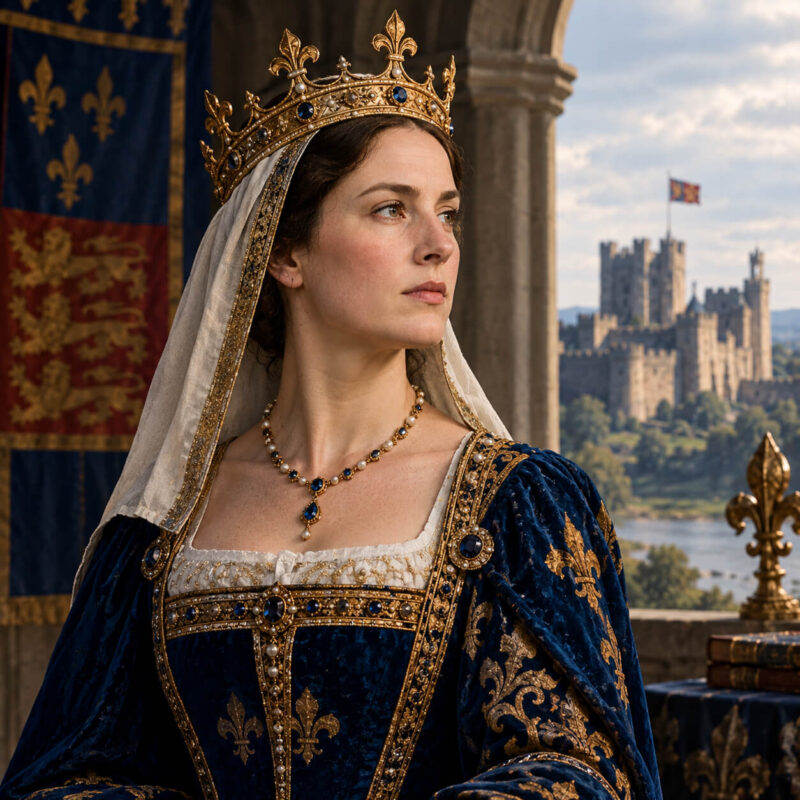
From the Norman court in France and of Viking blood, Emma of Normandy was born into Norman nobility and would become one of the most powerful women in Europe. She was the great-granddaughter of the Viking and first Duke of Normandy, Rollo Ragnvaldsson. She was queen consort to two kings of England, mother of two kings and stepmother to another.

It has been said that behind every great man is a great woman, and Emma of Normandy was no exception. And at times, she was well ahead of them.
Her political manoeuvrings helped guide the country through the Viking age and ensured that her sons would maintain the crown. She became the English, Danish, and Norwegian queen through her marriages to the Anglo-Saxon king Æthelred the Unready and the Danish king Cnut the Great.
In her lifetime she straddled Anglo-Saxon/Viking England, had huge land holdings across England and was at one time the richest woman in the country.
Born at the end of the Dark Ages in the late 900s, her parents were Richard I, Duke of Normandy and Gunnor, a Dane. Viking influence at this point had spread across the globe and had a firm base in both Northern France and Britain.
The house of Normandy was relatively small, especially in comparison to the English. In 1002, a political match was made for Emma to marry King Æthelred of England. King Æthelred was 20 years older than Emma and had already fathered 10 children with his first wife Aelfgifu.
Emma dutifully crossed the Channel and arrived in England aged around 12 to 15 years old to produce English-Norman heirs and strengthen the position of the House of Normandy. She was unable to speak the language, but she would eventually come to view England as home more than Normandy.
During this time England was under repeated attack from Viking raids. King Æthelred, known as Æthelred the Unready struggled to find ways to address the issues. His marriage to Emma, who was of Norman and therefore Viking heritage, was intended to calm the situation.
Emma proceeded to immerse herself in the day-to-day dealings of Æthelred’s court, and gained the respect amongst Anglo-Saxons who had initially been wary of her. Emma’s position was further guaranteed with the birth of two sons and heirs – Edward the Confessor and Alfred Ætheling, and a daughter named Goda.
Unfortunately Æthelred continued on his unwise course in opposition to the Danes, and on 13th November 1002 he ordered the massacre of all Danes in his lands. This plan to eradicate all Danes from England would become known to history as the St Brice’s Day Massacre. The massacre resulted in the murder of notable Danes such as Gunhilde, the sister of King Sweyn Forkbeard of Denmark.
Sweyn Forkbeard of Denmark invaded England in revenge for the massacre and for the murder of his sister. This resulted in Emma’s retreat to Normandy and into the protection of her father; her return home was embarrassing.
Æthelred managed to evade capture and established a residence on the Isle of Wight. While Sweyn Forkbeard established his kingdom in England with his sons Cnut (later Cnut the Great) and Harold, Emma could only watch and wait.
However, Sweyn wouldn’t rule England for long, and after a very brief rule, he died in 1014 and Æthelred and Emma returned home. However, when Æthelred died in 1016, Emma’s future was thrown into doubt once again.
Æthelred had 10 children from his first marriage and they took precedence over Emma and Æthelred’s sons. Edmund Ironside, Æthelred’s eldest son, had a fearsome reputation on the battlefield. As such he agreed a deal with Cnut, the son of Swyen, to split England in half and rule separate kingdoms.
This deal collapsed with the death of Edmund in 1016. Cnut took over the whole of England, and in an attempt to unite the past and the future, he asked Emma to be his wife. Emma was scarcely 30, Æthelred was dead, and Emma needed to secure her status, so she married the man who stole his crown. Despite this, Cnut and Emma’s marriage was a happy one. The couple had two children, Harthacnut and Gunhilda.
Emma was left to rule England alone on many occasions as Cnut travelled extensively to supervise the ruling of his North Sea empire. In a time when women were not valued on their own merits, Emma demonstrated that she was a woman to be reckoned with.
When Cnut died in 1035, his son with Emma, Harthacnut, took over as king of Denmark. Harold Harefoot, Cnut’s son with his first wife, took over the throne in England. Emma was once again left again in a difficult position.
In 1036, Alfred Ætheling and Edward the Confessor, Emma’s sons from her first marriage with Æthelred, returned to England from their exile in Normandy in order to visit their mother. Alfred attempted to come to her rescue, however he was betrayed, captured by Earl Godwin of Wessex, and blinded by holding a hot iron poker to his eyes; he died soon afterwards. Edward escaped the attack and returned to Normandy.
Emma fled England yet again, but this time headed north and convinced her son Harthacnut to return to England. His arrival coincided with the death of Harold Harefoot and Harthacnut was declared King of England. Emma once again was in the ascendancy and was now Queen Mother.
The untimely death of Harthacnut in 1042 left Emma initially unconcerned, as her son with Æthelred, Edward the Confessor returned from exile in Normandy and replaced him on the throne. However Edward did not have such a strong relationship with his mother. Displeased with Emma for previously supporting Harthacnut’s claim on the throne over his, he accused Emma of treason and deprived her of her lands and titles. However, Edward soon relented, and Emma’s lands and titles were restored.
Emma died on 6th March 1052 aged around 68 years old. After her death, she was interred alongside Cnut and Harthacnut in the Old Minster at Winchester, before being transferred to the new cathedral built after the Norman Conquest.
While Emma faded into obscurity, one of her direct relations would become one of England’s most famous rulers. Only 14 years after her death, England’s shores were invaded and conquered by her great nephew Duke William of Normandy, and would become more popularly known as William the Conqueror. Emma may not be remembered, but her House of Normandy most certainly is.
Did you enjoy this post?
I hope you found this post useful. I put a great deal of time and effort in to building, maintaining and populating the website. If you like, you could say a small thank you by buying me a coffee. You don't have to, but it would be nice :)
Buy me a coffeeMore People Profiles
View all People Profiles
Stay up to Date
Follow me on my journey and get notified whenever a new post is published by following Kings & Castles on Facebook.
Follow MeExplore The Map
Discover the hundreds of castles, churches, monasteries, cathedrals and other historic locations that I've personally visited across England and Wales. Search by location, explore nearby sites and plan your next historical adventure.
Share: