The Celtic Tribes of Britain
The Celts, Britons, Picts, Gaels and Scots were all ancient inhabitants of the British Isles from the Iron Age and throughout the medieval period. They were all distantly related tribes of Celtic origin, descendants of several waves of Bronze Age Celtic immigrants from the Continent.
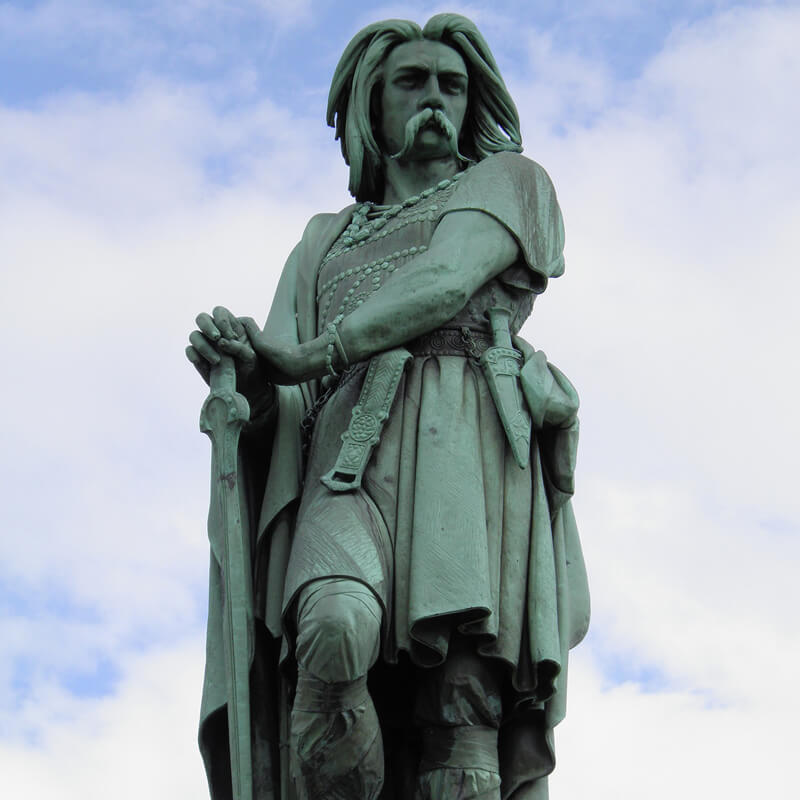
When the Celts arrived in the British Isles during the Bronze Age, those who settled in modern-day England and Wales became known as the Britons, or Celts. Those who crossed the Irish Sea and settled in Hibernia, modern-day Ireland, became known as Gaels. The Picts were the Iron Age descendants of the Bronze Age Britons, and they settled in Pictland, modern-day Scotland. The Scots evolved from an Irish clan of Gaels called Scoti, who eventually settled and gave their name to Scotland.
At this time, Celtic languages were spoken all across the British Isles. The Britons spoke Brythonic and the Picts and Gaels spoke Goidelic. Brythonic eventually evolved into Welsh, and Goidelic evolved into Irish and Scottish Gaelic. They all started out as pagan Celtic peoples who likely worshipped ancestors and nature, but they were eventually Christianised over several centuries.
The Britons
The Britons, commonly referred to as Celts, where Celtic tribes that migrated from mainland Europe between the 7th and 5th centuries BC and settled in modern-day England and Wales. They were more technically advanced compared to the earlier inhabitants, and they soon began to dominate political control and the culture of Britain.
They were powerful and numerous, made up of many different tribes, and well known for building defensive hillforts. Arguably the most well-known of the tribes was the Iceni of Norfolk and northwest Suffolk, famous for a revolt against Roman rule led by their warrior queen, Boudica. Other well-known tribes included the Brigantes who occupied almost the whole of northeast England, the Cantii of Kent, the Cornovii of Wroxeter and Shropshire, the Dobunni of Cirencester and Gloucestershire, the Dumnonii of Cornwall and Devon, the Durotriges of Dorset and Devon, the Ordovices of south Gwynedd and south Clwyd, and the Trinovantes of Essex and southern Suffolk.
However, they were never able to build a unified kingdom and prevent intertribal warfare. The total lack of political unity, despite their fierceness in battle, ultimately led to invasion and conquest by the Romans. When the Romans invaded, they saw them as nothing more than uneducated savages, and it was their mission to turn the country into a civilised Romano-British society, called Britannia.
The Britons and Romans spent decades fighting each other, the famous Boudican revolt happened in the first century AD, but the Romans held out and eventually turned Britannia into an important Roman province. The Romans turned the uncivilised and chaotic Celtic kingdoms of Britannia into a place with roads, towns, learning and civilisation, along with prosperity and a new advanced religion, Christianity.
When Christianity was legalised in the Roman Empire in the 4th century it became the major religion of the Empire, including the Roman province of Britannia. Christianity gained a strong following at all levels of Romano-British society by the 4th century, but pagan beliefs still lingered. The Romans never managed to conquer Pictland and Hibernia, and now mostly Christianised, the Britons looked down upon the Gaels and the Picts as uncivilised, savage pagans, while they saw the Britons as softened would-be Romans. The Roman emperor Hadrian famously built Hadrian’s Wall in the second century AD to keep the pagan Picts out of Christian Britannia, who were at one point basically Britons themselves.
In the early 5th century, Rome was attacked by Germanic tribes and the Roman legions left Britannia to return to their homeland to help save their empire. When they left, money was no longer being minted in Britain, and as a result, trade and the economy collapsed, as did the Roman way of life. The departure of the Romans created a power vacuum, and a struggle between the native Britons ensued. They turned against each other, plundering to avoid starvation, and those who could, fled overseas.
The Britons were left vulnerable and alone. As well as internal fighting amongst themselves, Hadrian’s Wall was no longer defended by Roman soldiers, leaving the Picts and Irish raiders to invade. The Britons wrote to Rome asking for help but no help came and they were left to defend and support themselves. The Britons then turned to groups of West Germanic tribes from across the English Channel for help, the Anglo-Saxons.
The Anglo-Saxons were invited as mercenaries to fight Britain’s battles against the Pictish and Irish raiders. Germanic tribes were often used to fight as mercenaries, the Romans used them regularly to fight alongside their legions. The difference was, the Roman Empire had lots of money, the Britons didn’t. The arrangement worked for a short time, but once the Anglo-Saxons were unpaid and unfed, the arrangement broke down and backfired. They plundered the country and there was nothing the Britons could do to stop them. Many Britons became slaves, many fled west to the western parts of the country, thousands more fled overseas to the continent. Britannia was turned into a bunch of pagan Anglo-Saxon kingdoms until it eventually became Christian England later in the medieval period. They began referring to the country as ‘Anglia’ and later as ‘Engla-land’, literally meaning “the land of the Angles” where they spoke ‘Englisc’ or ‘Ænglisc’, and this is where the words ‘England’ and ‘English’ originated from.
Meanwhile, native British society clung on in Cornwall, Wales, and in the north west, but the ancient Brythonic language eventual faded away, becoming Breton, Cornish and Welsh many generations later. The Anglo-Saxons referred to the native Britons in Wales as ‘wealh’, ‘wēalas’ and ‘wælisc’, which is a somewhat derogatory term meaning ‘slaves’, ‘foreigners’ or ‘strangers’, and this eventually evolved into the modern name for their territory, Wales. Similarly, they referred to the Dumnonians, the native Britons in Cornwall, as the ‘cornwælisc’ or ‘cornwealha’, which over time evolved into its modern place name, Cornwall.
The Gaels and the Scoti
The first Celts arrived in Hibernia (Ireland) from mainland Europe via Britain, likely beginning around 600 BC. They called themselves Gaels, hence the term Gaelic. And after a slow trickle of migration they began to flood the island between 350 and 150 BC. Bringing an advanced Iron Age culture, in comparison to Ireland’s earlier Stone Age inhabitants, the Celtic culture slowly surpassed the previous one and the Gaels were dominant by the first century BC.
Ireland existed as a relatively isolated corner of Celtic culture during the Roman era and remained unconquered by the Romans. But because of this, Ireland was still in the Iron Age; an uncivilised place full of warring clans, pirates and barbarians. It was a pagan and violent land made up of lots of small kingdoms ruled over by different kings, where its wealth was measured in cattle. The Romans called it Hibernia, ‘the land of winter’.
One group in particular was the Scoti, who were raiders, often outlawed from their original clans, who occupied the northeastern area of Ireland. In around 500 AD, the Romans began to refer to Ireland as Scotia, named after the Scoti, meaning ‘Land of the Scots’, replacing the previous name Hibernia. For generations, Scoti territory had been expanding, and some time in the late 5th century they founded a kingdom known as Dalriada, which straddled both sides of the Irish Sea. Dalriada encompassed northeastern Ireland and western Pictland, including the great islands off the Pictish coast, which is now modern-day Argyle in Scotland. As a result, the use of the name Scotia later shifted in the Middle Ages and eventually gave its name to a new nation, Scotland.
In the 5th century, a Romano-British Christian missionary and bishop by the name of Patrick, born at the end of Roman rule in Britain, helped to spread Christianity across Ireland. Patrick, who is now the patron saint of Ireland, was taken from Britain and sold into slavery in Ireland at the age of 16. In captivity, Patrick turned to god. Several years later he escaped back to Britain, but back in his homeland, order had turned to anarchy as a result of the Roman legions returning back to Rome. But after having a dream in which he heard the “voice of the Irish” begging him to convert the people of Ireland to Christianity, he became a Christian missionary and returned to convert the barbarian Irish, the ones who had once enslaved him.
Paganism ran deep in ancient Ireland. It was a religion of human and animal sacrifice, and was a place of sacred woods and trees, presided over by druids, the pagan religious leaders. But Patrick was destined to change Britain and Ireland forever. He preached the gospel to the pagans, apparently starting the process by converting the High King of Ireland which caused a trickle down effect. It offered them a better way of life that was more rewarding and satisfying, with learning, reading and writing being a major selling point.
Eventually, the sacred water of the druids became the holy water of baptism, and pagan sanctuaries were transformed into Christian alters. Patrick successfully converted Ireland into a stronghold of Christianity, spreading a measure of Romanisation that had never occurred there previously. Ireland remained Christian throughout the following centuries, and Irish missionaries would go on to play a crucial role in converting the pagan Picts, and as a result, turn their homeland into Scotland.
The Picts and the Scots
The Picts were essentially a group of northern Britannian tribes. Whilst technically Britons like the other Celtic tribes of Britain, they escaped the grasp of the Romans, avoiding being part of or integrated into the Roman province of Britannia, and eventually distinguished themselves from the Romano-British.
Like many Celtic tribes in Britain, they were hillfort builders and farmers who defeated and were defeated by the Romans on several occasions. Also like the Celtic tribes, they too were divided into many different clans, the most famous being the Caledonii. The Romans referred to their territory as Caledonia and initially included them as Britons, but were later distinguished as the Picts. They were cut off by Hadrian’s Wall and their lands became known as Pictland.
The Picts were famous for their artful body paintings and tattoos, customs which had once also been known among some of the southern Britons and the Irish clans, but had been largely abandoned in Britannia during Roman rule. It is because of this how the Picts got their name. ‘Pict’ comes from the Roman name Picti, meaning ‘painted people’ referring to their practice of tattooing or body painting.
The clans of Pictland weren’t only made up of northern Celtic Britannian peoples and the descendants of the older Caledonians, some of their western clans were related to the northeastern Scoti of Ireland, who were possibly more closely related to the Picts than the other Gaels of Ireland. The clans of Pictland didn’t refer to themselves as Picts, but rather saw themselves as “old Britannians” or “real Britannians”, but mostly they only applied to themselves their local clan names, as they didn’t identify as one single or united people.
Like the Britons and Irish before they were Christianised, the Picts were pagans and followed the Druidic religion where they revered nature, animals, old ancestors, and water and mountain gods. But they too would eventually become Christianised.
In the year 563, 12 Irish monks from Dalriada, led by Columba, established a Christian church and community on the nearby island of Iona, from where they set out to convert the pagan Picts. In the late 560s, Columba set out into the dangerous Pictish territories, reaching the other side of Pictland to modern-day Inverness, far from the safety of Dalriada and Iona. Pictland at this time was practically still in the Iron Age, and the Pictish king and his people saw Christianity as a new kind of magic, recognised it as a greater power, and they began to convert en masse.
By adopting Christianity, replacing their age-old pagan beliefs, it had a dramatic change on their politics and identity, changing them into a new people. Their language faded away and they became Gaelic speakers, just like the Irish monks who had brought them their new religion from Iona. Eventually they lost their name and became, along with the Gaels of Dalriada, Scots.
In the 9th century Pictland became the kingdom of Alba, the precursor to Scotland, which was formed by the union of the Picts and Scots. But by the end of the 10th century the Picts had seemingly vanished, most likely assimilated by the Scots, and it became the land of the Scots, who were originally from Ireland. By the 11th century the Pictish language and identity had been forgotten, and soon, thanks to Christianity, Columba and the Irish monks, the kingdom of Scotland was formed.
Did you enjoy this post?
I hope you found this post useful. I put a great deal of time and effort in to building, maintaining and populating the website. If you like, you could say a small thank you by buying me a coffee. You don't have to, but it would be nice :)
Buy me a coffee
Stay up to Date
Follow me on my journey and get notified whenever a new post is published by following Kings & Castles on Facebook.
Follow MeExplore The Map
Discover the hundreds of castles, churches, monasteries, cathedrals and other historic locations that I've personally visited across England and Wales. Search by location, explore nearby sites and plan your next historical adventure.
Share: