The Christian Conversion of Britain
Christianity started to take root in Roman Britain from the 2nd century AD when Roman merchants shared stories with the locals about Jesus and his disciples.
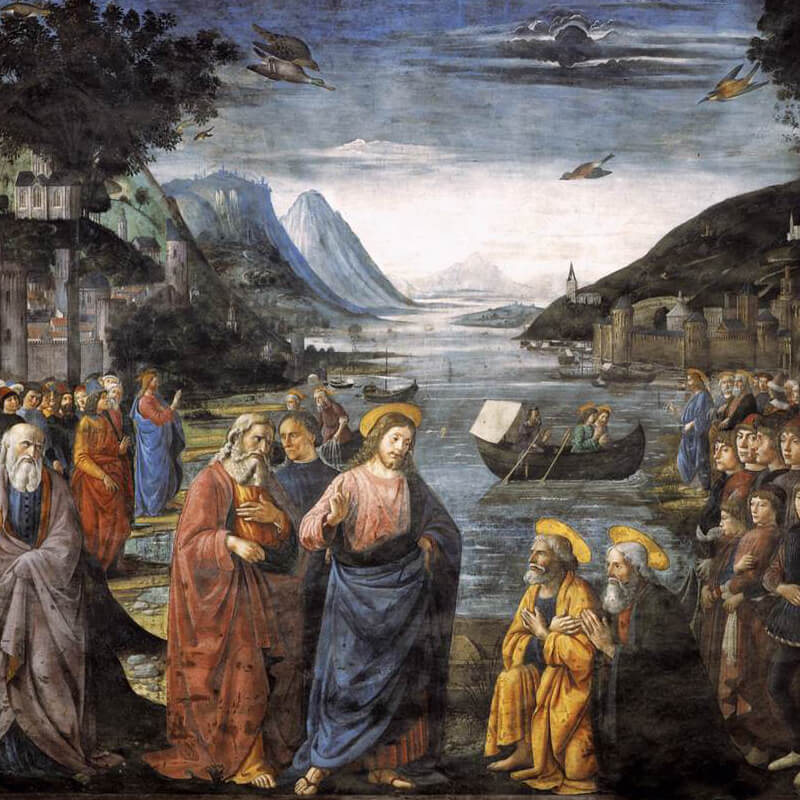
The conversion of Britain and Ireland to Christianity happened in several waves over many centuries. The first wave happened in Roman times from the 2nd to 5th centuries when the Romans converted the native pagan Britons. Then, Ireland converted, followed shortly by the Picts in modern-day Scotland. Next was the pagan Anglo-Saxons which converted between the 6th and 8th centuries when Christian missionaries travelled from Rome and Ireland. Finally, the Vikings that were living in the British Isles in the 9th to 11th centuries were converted to Christianity, mainly influenced by other Vikings from Scandinavia.
Roman Britain (England and Wales)
Before the Romans arrived, Britain was a pre-Christian society made up of pagan Celtic peoples. The native inhabitants of the British Isles at the time of the Roman invasion were the Britons, or Celts, who lived in Britannia, modern-day England and Wales. To the north were the Picts who lived in Pictland, modern-day Scotland. Across the Irish sea in the land of Hibernia, modern-day Ireland, were the Gaels. They were all pagans who likely worshipped ancestors and nature. The Britons, Picts and Gaels were all distantly related tribes of Celtic origin, descendants of several waves of Bronze Age Celtic immigrants from the Continent.
The Romans saw them as uneducated savages, and it was their mission to turn Britannia into a civilised Romano-British society. The ancient Britons and the Romans spent decades fighting each other, the famous Boudican revolt happened in the first century, but the Romans held out and eventually turned Britannia into an important Roman province.
When Christianity was legalised in the Roman Empire in the 4th century it became the major religion of the Empire, including the Roman province of Britannia. Christianity gained a strong following at all levels of Romano-British society by the 4th century, but pagan beliefs still lingered. The Romans never managed to conquer Pictland and Hibernia, and now mostly Christianised, the Britons looked down upon the Gaels and Picts as uncivilised, savage pagans, while they saw the Britons as softened would-be Romans.
The Gaels (Ireland)
In the 5th century, a Romano-British Christian missionary and bishop by the name of Patrick, born at the end of Roman rule in Britain, helped to spread Christianity across Hibernia, the Classical Latin name for Ireland. Patrick, who is now the patron saint of Ireland, was taken from Britain and sold into slavery in Ireland at the age of 16. Several years later, he escaped captivity and returned to Britain. However, after having a dream in which he heard the “voice of the Irish” begging him to convert the people of Ireland to Christianity, he became a Christian missionary, returned to Ireland and successfully converted the country into a stronghold of Christianity.
Although Patrick is credited with converting much of the Irish race from paganism in the mid 5th century, by the time he began his mission the groundwork had likely already been done and the foundations laid for a Celtic Church in Ireland. Christianity entered Ireland presumably in the 4th and early 5th centuries, by a slow and gradual process of unplanned infiltration from Britain and the Continent, via trade with Christians and Christian slaves, bringing their Christian religion with them. Ireland remained Christian throughout the following centuries, and Irish missionaries played a crucial role in converting the pagan Picts and Anglo-Saxons.
The Picts (Scotland)
The ancient Irish were expansionists. For generations, Irish territory had been expanding, and the Irish region of Dalriada straddled both sides of the Irish Sea. It’s people were known as Gaels, or Scoti, and they eventually gave their name to a new nation, Scotland. Dalriada encompassed northeastern Ireland and western Pictland, which is now modern-day Argyle in Scotland.
In the year 563, 12 Irish monks, led by Columba, established a Christian church and community on the nearby island of Iona, from where they set out to convert the pagan Picts. What started out as a deserted remote location soon became an important and famous religious centre, and the monastic community quickly grew and thrived. In the late 560s, Columba set out into the dangerous Pictish territories. He reached the other side of Pictland, to modern day Inverness, far from the safety of Dalriada and Iona.
Pictland at this time was practically still in the Iron Age. Christian kingdoms had moved on and become centres of learning and technology. The Pictish king and his people saw Christianity as a new kind of magic, recognised it as a greater power, and they began to convert en masse. They also knew about the Roman Empire and realised that people that followed Christianity were rich, prosperous and powerful people, and it brought civilisation. To Iron Age people like the Picts, this was very attractive and difficult to resist.
The Picts adopted Christianity, replacing their age-old pagan beliefs, which had a dramatic change on their politics and identity, changing them into a new people. Pagan Pictland was on its way to becoming Christian Scotland. Their language faded away and they became Gaelic speakers, just like the Irish monks who had brought them their new religion from Iona. In time, they would even lose their name and become, along with the Gaels of Dalriada, Scots.
In the 9th century Pictland became the kingdom of Alba, the precursor to Scotland, which was formed by the union of the Picts and Scots. But by the end of the 10th century the Picts had seemingly vanished, most likely assimilated by the Scots, and it became the land of the Scots, who had originally come from Ireland. By the 11th century the Pictish language and identity had been forgotten, and soon, thanks to Christianity, Columba and the Irish monks, the kingdom of Scotland was formed.
The Anglo-Saxons
Roman rule in Britain ended at the start of the 5th century, but Christian faith persisted in British society. After the departure of the Roman army, the Britons recruited pagan Germanic tribes from the Continent called the Anglo-Saxons to help defend Britain against the invading Picts. But despite their common ancestry, the Anglo-Saxons turned on the Britons, overpowered them with ease and decided to stay, and Christianity in Britain was challenged.
The invading early Anglo-Saxons were pagans, and they brought with them the resurgence of Germanic-inspired Anglo-Saxon paganism. They believed in a range of gods which had developed from the same Germanic belief system that inspired the Vikings. The Anglo-Saxon god Woden, the all-powerful king of gods, is similar to the Viking god Odin, while Thunor, the god of thunder, is the Anglo-Saxon version of Thor. They also had the war god Tiw and the fertility goddess Frigg. These gods gave their names to Tuesday (Tiw’s day), Wednesday (Woden’s day), Thursday (Thor’s day) and Friday (Frigg’s day).
The Anglo-Saxons believed in lucky charms and thought that rhymes, potions, stones and jewels would protect them from evil spirits or sickness. As they slowly advanced across the country, Christianity had almost been wiped out. The Britons were pushed into the west of the country, where Christianity survived in the Brittonic kingdoms of modern-day Cornwall and Wales. Therefore, the early medieval churches of Wales, Scotland and Ireland shared common characteristics often described as Celtic Christianity. The Anglo-Saxons took the rest of the country for themselves, creating many separate kingdoms which would eventually become England. As part of this process, elements of culture such as Germanic paganism became widespread, and a new Anglo-Saxon culture developed, including Anglo-Saxon paganism and the Old English language.
Hadrians Wall was built by the Romans to keep the barbarian Picts out of civilised Christian Britain. But now it marked a different boundary, and a dramatic reversal of roles. In the days of the Romans, on the side of the wall in Pictland, it had been barbaric, wild and pagan, but now Christianity was taking hold, with law and literacy. But on the side that was once Roman and Christian was neither of those things. Pockets of Christianity held out, but the majority of what was Roman Britannia was now in the hands of the pagan Anglo-Saxons.
It wasn’t until the 7th century, and a papal mission sent from Rome by Pope Gregory I, also known as Gregory the Great, that the conversion of England began. In 597, the same year that Columba of Iona died, a monk named Augustine arrived in Kent from Rome with the mission to convert the Anglo-Saxons to Christianity. He first converted the pagan Anglo-Saxon king Æthelberht, King of Kent, in around 601. Augustine founded a monastery, later known as St Augustine’s Abbey, and established a church at Canterbury, becoming the first Archbishop of Canterbury, from which he began to convert the people of Kent. Attempts were made to convert London, which were temporarily successful, until it reverted back to paganism.
About 30 years later one of Augustine’s fellow missionaries, Paulinus, baptised King Edwin of Northumbria at York, but the majority of the kingdom remained pagan. Shortly after, missionaries started preaching in East Anglia and Hampshire, where King Rædwald was converted, and more and more Anglo-Saxon kings and their people became Christians. Pagan shrines were turned into churches, magic water became holy water, and various pagan gods were gradually replaced with Christian saints.
Another mission was lunched in the north in the kingdom or Northumbria, which was the most powerful of the Anglo-Saxon territories at the time. In 634, a new king called Oswald arrived at Bamburgh Castle, at the heart of his Northumbrian kingdom. He’d spent 18 years living in exile with his brother Oswiu in the Irish kingdom of Dalriada in present-day Scotland after their father’s death at the hands of Edwin of Northumbria, and they became Christian, only returning to Northumbria after Edwin’s death in 633. With the help of Aiden, the last of the great Irish missionaries, Oswald was determined to turn his pagan kingdom into a Christian one. Under the patronage of King Oswald, Aiden established a monastery in 635 on the island of Lindisfarne, also known as Holy Island, just off the Northumbrian coast. Lindisfarne quickly grew in importance and became a base for Irish Christian missions to the mainland. King Oswald successfully converted his nobles, whilst Aiden freed and converted slaves, and other Irish missionaries converted the rest of the Northumbrians.
In the middle of the 7th century, the king of Mercia and his people converted to Christianity. However, as more and more English priests and nobles began to choose the Roman ways of Christianity over Irish ways, tensions grew. Their main argument was over the question of the dating of Christianity’s most important festival, Easter. When Oswald died, his brother Oswiu succeeded as King of Northumbria. He grew up in Dalriada where he learned his Christianity from the Irish priests, whereas his wife, the queen, had been brought up in Kent, where they adhered to Roman teachings.
The two traditions disagreed on the timing of Easter, and a power struggle began between the two Christian factions, the Irish Church and the Church of Rome. In 664 at Whitby Abbey on the Yorkshire coast, King Oswiu called a synod to resolve the dispute once and for all, the famous Synod of Whitby.
Wilfrid, an English bishop born a Northumbrian noble, who entered religious life as a teenager and studied at both Lindisfarne and at Rome, wanted to move away from Celtic to the more orderly Roman Church. The fight to keep Celtic traditions was fought by Aiden’s successor at Lindisfarne, Colmán. After a few days of deliberation, the King of Northumbria reached his decision and chose the Roman Church, making England part of mainstream Christian Europe.
This was a major blow for the Irish followers of Columba. The monks of Lindisfarne weren’t prepared to tolerate being told that their ways were wrong, so they packed their bags and took the relics of St Aiden from Lindisfarne and took them to Iona. However, as a result of the Synod of Whitby, the prestige of Iona was never the same again. The Irish had brought the power of Christianity to Anglo-Saxon England, and they used that power against them.
In the last decades of the 7th century, Bishop Wilfrid began converting Sussex, the last Saxon kingdom to become Christian. There was the odd relapse into paganism from time to time throughout the decades, but by the end of the 7th century Christianity had spread across Britain, and the Anglo-Saxon kings continued to be baptised into the 8th century and beyond as Christianity became increasingly entrenched in Anglo-Saxon culture. Although the missions from Rome succeeded in baptising several Anglo-Saxon kings, it was the Irish missionaries in East Anglia and Northumbria that paved the way for the grass-roots conversion of the general Anglo-Saxon population.
Christianity brought new technologies such as building in stone, as well as learning, such as reading, writing and written law. Monasteries and churches were everywhere in Christian Anglo-Saxon England, becoming important centres of learning, where monks and nuns spent their time in prayer and study, and where boys and girls lived to train as monks and nuns.
The Vikings
During the Viking Age, circa 793 – 1066, settlers from Scandinavia reintroduced paganism to eastern and northern England. Just like the early Anglo-Saxons, the Norse and Danish Vikings were fiercely pagan. They did to the Anglo-Saxons what the Anglo-Saxons did to the Britons centuries earlier. The early Anglo-Saxons were pagan and came from roughly the same area as the Danish Vikings, generations later, with a similar pagan belief system and pagan gods.
In the late 700s the Vikings descended on the monasteries of the British Isles. Iona was attacked multiple times. In one particular raid, 68 monks, nearly the entire community, were taken to the beach at Iona and slaughtered, and has been known as Martyrs Bay ever since. They also attacked the famous monastery at Lindisfarne in 793, and laid waste to Whitby, Tynemouth Priory and many others, almost destroying the Church in the north and east of England. This was replicated right across Britain and Ireland, and the great age of Irish Christianity was brought to a bloody end.
Viking raids continued for the next several decades until the Great Heathen Army, made up of combined forces of Danish Vikings, invaded in 865, from which point they began to settle in the British Isles. They butchered whoever stood in their way, and destroyed as many churches and monasteries as they could, with the aim of wiping out Christianity and taking over the entire country.
Alfred the Great, King of Wessex, famously baptised the Viking warlord Guthrum as a Christian and became his godfather after defeating him in battle, which led to the creation of the Danelaw. Alfred and his successors laboured to revive the Church, and were soon aided by Christianised Scandinavian settlers. These were among the first Vikings to revere the holy Anglo-Saxon King Edmund of East Anglia, whom their ancestors had martyred in 869, later embracing him as a martyr for the Christian faith.
The conversion to Christianity for the Vikings happened within a few generations, with the last potentially heathen king being Eric Bloodaxe, who ruled in York until 954 when he was driven out by Eadred, King of the English. As well as the usual missionary efforts, the Vikings gradually converted to Christianity through a combination of political and economic factors. The Vikings traded with Christian areas of Europe, and Viking rulers wanted to form alliances with Christian kingdoms to the south, which led them to consider Christianity.
The first Danish king to convert to Christianity was Harald Bluetooth in around 965. He used Christianity to strengthen his power and gain support from Christian kingdoms in Europe. He was the father of Sweyn Forkbeard and the grandfather of Cnut the Great, both of whom would come to rule England.
Olaf Tryggvason, King of Norway from 995 to 1000, made it his priority to convert his country to Christianity using all means at his disposal. He expanded his efforts to the Norse settlements around the British Isles, including the Faroes, Orkney and Shetland, even as far as Iceland and Greenland. Olaf Haraldsson, King of Norway from 1015–1028, led another wave of Christian conversion in Norway between 1015 and 1030.
With all this widespread Scandinavian Christian conversion happening, this influence was imported into mainland England with the mass emigration of Danes. Over time, the Danish settlers in England were no longer pagan, but Christian. This was especially the case when Cnut the Great ruled England from 1016 until his death in 1035.
In the 11th century, monasteries were founded or re-established, often following the popular Europe-wide Benedictine rule. These included Westminster Abbey in London and Deerhurst Priory in Gloucestershire.
The Normans
The Normans were the next, and last, invaders of England, but they were also fiercely Christian. They invaded England in 1066 and within a decade of the Norman Conquest many of the traditions of the English Church were swept away, but Christianity continued to flourish.
The Normans brought with them a new set of Norman and French churchmen to power and introduced several religious orders to England, including the Benedictines, Cluniacs, Cistercians, and Augustinians, and they rebuilt and re-founded Saxon churches and monasteries all over the country. Finally, the Dominican and Franciscan Friars arrived in England from Europe in the 1220s and built friaries in most towns.
Did you enjoy this post?
I hope you found this post useful. I put a great deal of time and effort in to building, maintaining and populating the website. If you like, you could say a small thank you by buying me a coffee. You don't have to, but it would be nice :)
Buy me a coffee
Stay up to Date
Follow me on my journey and get notified whenever a new post is published by following Kings & Castles on Facebook.
Follow MeExplore The Map
Discover the hundreds of castles, churches, monasteries, cathedrals and other historic locations that I've personally visited across England and Wales. Search by location, explore nearby sites and plan your next historical adventure.
Share: