Edmund the Martyr
Edmund the Martyr was a warrior king of Anglo-Saxon England who was slain by the Vikings in the late 9th century, and subsequently became a martyr and saint. In fact, he was the first patron saint of England, centuries before St George stole his title.
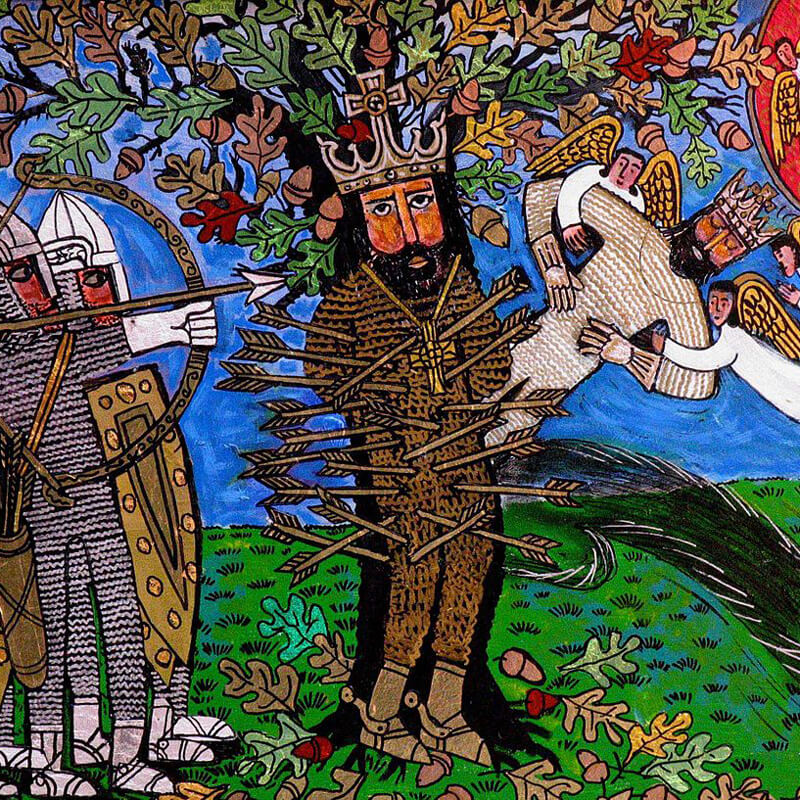
Edmund the Martyr, also known as St Edmund or Edmund of East Anglia, was the king of the Anglo-Saxon kingdom of East Anglia (King of the East Angles) from about 855/856 until his death in 869.
Few historical facts about Edmund are known, as the kingdom of East Anglia was devastated by the Vikings, who destroyed any contemporary evidence of his reign. We know that he was born around 841/842, was of East Anglian origin, and coins minted by Edmund indicate that he succeeded Æthelweard of East Anglia. Edmund’s death was mentioned in the Anglo-Saxon Chronicle, which tells us that he was killed in 869 after the Great Heathen Army advanced into his kingdom of East Anglia.
Brought up as a Christian, Edmund fought alongside King Alfred of Wessex (Alfred the Great) against the Great Heathen Army; a sizeable combined force of pagan Danish and Norse Viking invaders that landed in England in 865. However, in 869 or 870 Edmund’s forces were defeated and he was captured by the Vikings. They devastated East Anglia, destroyed any evidence of Edmund’s reign, and he was ordered to renounce his faith and share power with the pagan Vikings, but he refused.
Historical sources say that Edmund was then bound to a tree, shot through by arrows and beheaded. It’s uncertain where he was killed; some accounts state Bradfield St Clare near Bury St Edmunds, others say Maldon in Essex or Hoxne in Suffolk. What is known is that in 902 the remains of the martyr king were moved to Beodericsworth (modern Bury St Edmunds) where King Æthelstan founded a religious community to care for his shrine, which was said to have performed miracles and became a place of national pilgrimage. By 925 the fame of St Edmund had spread far and wide, and the name of the town where he was buried was changed to St Edmund’s Bury, and later to Bury St Edmunds.
King Cnut the Great built a stone Benedictine abbey on the site in 1020 to house Edmund’s shrine, and for centuries his resting place was patronised by the kings of England, and the cult of St Edmund grew. St Edmund’s cult flourished so much during the Early and High Middle Ages that he was regarded as the patron saint of medieval England, making him the country’s first patron saint.
On St Edmund’s Day in 1214, English barons met at the abbey where they swore an oath to compel King John to agree to the Charter of Liberties, the precursor to Magna Carta which he signed a year later. This event gave the town of Bury St Edmunds its motto: “Shrine of a King, Cradle of the Law”. It refers to the town’s history as both a burial place for King Edmund and as a site of the meeting that led to Magna Carta; the law that gave Englishmen their freedom.
Unfortunately for Edmund, his influence began to fade from the beginning of the 12th century when King Richard I (Richard the Lionheart) visited the tomb of St George in Lydda on the eve of battle during the Third Crusade. The next day he won a great victory, and as a result, Richard attributed his triumph to St George and decided to adopt him as his personal patron and protector of the army. The banner of St Edmund was still carried into battle by the English army, but by the time of Edward I it had been joined by the flag of St George. In 1348, Edward III founded a new order of chivalry; The Order of the Garter, also known as the Knights of the Garter. Edward dedicated the Order to St George and also declared him patron saint of England, replacing Edmund.
St George was a foreigner, a 3rd-century Roman soldier born in modern-day Turkey. He is also the patron saint of 16 other countries and never stepped foot on British soil. Therefore, recent attempts have been made to reinstate Edmund as patron saint of England as he was an Englishman and a martyred Anglo-Saxon king… St Edmund has not been forgotten.
Did you enjoy this post?
I hope you found this post useful. I put a great deal of time and effort in to building, maintaining and populating the website. If you like, you could say a small thank you by buying me a coffee. You don't have to, but it would be nice :)
Buy me a coffeeMore People Profiles
View all People Profiles
Stay up to Date
Follow me on my journey and get notified whenever a new post is published by following Kings & Castles on Facebook.
Follow MeExplore The Map
Discover the hundreds of castles, churches, monasteries, cathedrals and other historic locations that I've personally visited across England and Wales. Search by location, explore nearby sites and plan your next historical adventure.
Share: