The Plantagenets
The House of Plantagenet is England’s longest reigning royal house, spanning over 300 years and providing us with 14 kings, six of whom belonged to the cadet houses of Lancaster and York. A lot happened during the reign of this troubled dynasty, the most famous being the signing of the Magna Carta, the Crusades, the Hundred Years’ War and the Wars of the Roses.
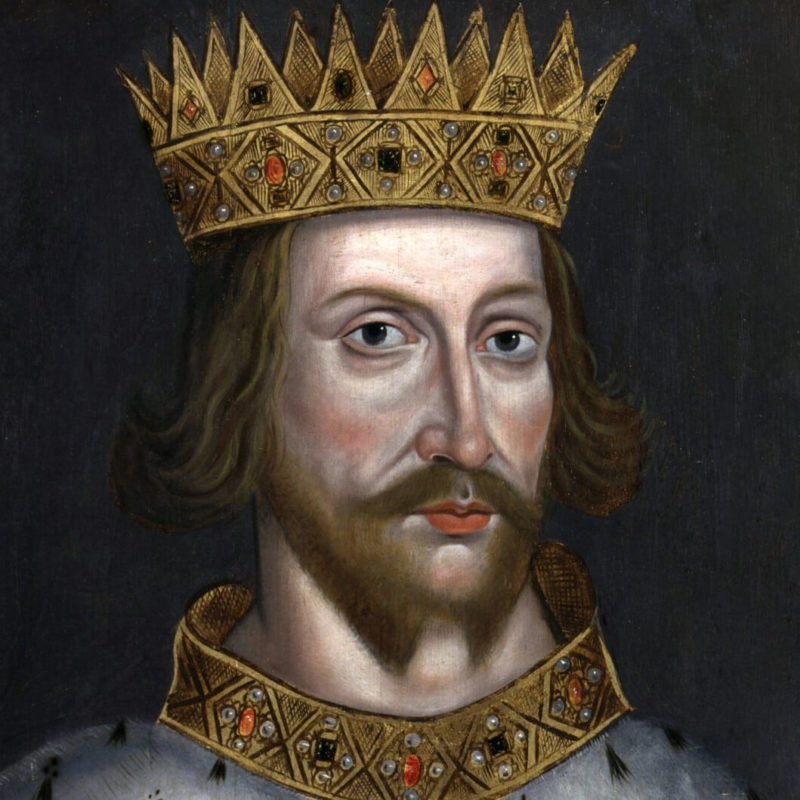
Spanning a period of 331 tumultuous years, from 1154 to 1485, England was ruled by one family. Every king during that time was a descendant in the male line of Geoffrey Plantagenet, Count of Anjou, whose badge, the broom plant – planta genista in Latin – is the origin of their name: the Plantagenets. Geoffrey Plantagenet was the husband of Empress Matilda and the father of Henry II. Here are the 14 Plantagenet Kings.
- Henry II (1154-1189)
- Richard I (1189-1199)
- John (1199-1216)
- Henry III (1216-1272)
- Edward I (1272-1307)
- Edward II (1307-1327)
- Edward III (1327-1377)
- Richard II (1377-1399)
- Henry IV (1399-1413)
- Henry V (1413-1422)
- Henry VI (1422-1461 & 1470-1471)
- Edward IV (1461-1470 & 1471-1483)
- Edward V (1483)
- Richard III (1483-1485)
Origins
The Plantagenet dynasty originated in France and therefore French was their native language, just like the dynasty that preceded them, the Normans. The House of Plantagenet was also know by another name, the House of Anjou. Therefore, as well as being known as The Plantagenets, they were also known as The Angevins (from the French term meaning “from Anjou”) and they ruled over the Angevin Empire from 1154 to 1216, which included roughly all of England, half of France and parts of Wales and Ireland. The Angevin kings of England were Henry II and his sons Richard I and John, until John lost the Duchy of Normandy and most of his other French lands to King Philip II of France, resulting in the collapse of the Angevin Empire.
Henry II
Geoffrey Plantagenet made his son Henry the Duke of Normandy in 1150, and when he died a year later, Henry inherited Anjou, Maine and Touraine. His marriage to Eleanor of Aquitaine brought him control of the Duchy of Aquitaine. All of this meant that he controlled most of France. Henry became Henry II, King of England in 1154, and the first Plantagenet king, after the death of the last Norman king, Stephen. A treaty was signed between the two, which brought the conflict known as ‘The Anarchy‘ to an end and named Henry as Stephen’s successor. One thing that would forever taint his reign was the murder of Thomas Becket. Thomas and the king used to be close friends. Henry had a desire to control the English Church and decided to make his good friend Thomas the Archbishop of Canterbury. However, this led to conflict between the two of them that lasted for much of the 1160s and resulted in Becket’s murder in the year 1170 at the hands of four of Henry’s knights, and everyone hated Henry for this.
Henry and Eleanor had eight children, two of whom would rule as king after his death. As his sons grew up his relationship with them grew more and more fractured as he struggled to find ways to satisfy their desires for land and immediate power. His sons became greedy and impatient and tensions rose over the future inheritance of the Angevin empire. Several battles ensued between Henry and his sons over many years, and his wife Eleanor would always side with their sons. She attempted to overthrow her husband in favour of her sons and for this she was locked up for 16 years. Henry died broken-hearted in 1189 and his eldest surviving son Richard would succeed him as king.
Richard I
Richard became Richard I, King of England in 1189. He was also known as Richard the Lionheart because of his reputation as a great military leader and brave warrior. He was a Christian leader in the third crusade and he achieved several victories over his Muslim enemy, Saladin. Richard famously disliked England for several reasons, one of those reasons being the terrible weather, and during his 10 year reign he spent a mere six months in England. Richard I died in 1199 and his younger brother John became the next Plantagenet king of England.
King John
John was the youngest and favourite son of Henry II, and before his ascension to the throne he was nicknamed John Lackland (John without land) because he inherited significantly less lands than his other brothers. Although, upon ascending the throne he acquired all of the lands within the Angevin Empire by right. Up until this point, the French crown was relatively weak, which allowed his brother Richard and his father Henry to dominate France for so many years before him. However, by 1206 he had lost most of his French lands to King Philip II of France including Normandy, Anjou and Maine, which resulted in the collapse of the Angevin Empire. John was a tyrannical and cruel king. He also raised taxes for unsuccessful military campaigns to try to reclaim his lost lands in France and as a result he faced a rebellion by many of his barons, who were unhappy with his fiscal policies and his treatment of many of England’s most powerful nobles. This led to the First Barons’ War. A peace treaty called Magna Carta was draughted between John and the barons and was agreed in 1215. It was written to protect the rights and property of the nobles against the tyrannical king. However, its conditions were broken and civil war broke out shortly afterwards which ended in a stalemate. John died of dysentery in 1216 and would be succeeded by his son Henry.
Henry III
King John’s son Henry became King Henry III in 1216 and ruled England for 56 years, which would be the longest rule of any British monarch for over 500 years. However, he was viewed as a weak ruler whose untrustworthiness led to the Second Barons’ War from 1264 to 1267. He wasn’t a tyrant, he was kind, pious and generous, but he was useless and careless, which resulted in a reduction in royal authority. Henry III died in 1272 and was succeeded by his son Edward, who would become Edward I.
Edward I
Edward I was tall, strong, athletic and a very capable military leader, a veteran warrior with a formidable temper. He was nicknamed Edward Longshanks and the Hammer of the Scots; Longshanks because of his long legs, and Hammer of the Scots because of his relentless pursuits of Scotland. However, before his attentions turned to Scotland he was heavily invested in subduing the Welsh and taking Wales for himself. He conquered northern Wales and made it a principality in 1284. He built many massive and imposing castles in the north of Wales which were called the ‘Iron Ring‘. These castles included Flint, Rhuddlan, Caernarfon, Conwy, Harlech and Beaumaris. The largest and most formidable of these castles was Caernarfon Castle, which was where Edward and his wife spent much of their time. Their son Edward was born at Caernarfon castle, after which he was given the title the Prince of Wales, and since 1301 the heir to the English throne has carried the title Prince of Wales by default. After he conquered the Welsh he turned his attentions to Scotland. For more than 100 years relations between England and Scotland had been amicable and peaceful. However, Edward would eventually conquer Scotland (very temporarily) in 1296 and start 250 years of bitter hatred and savage warfare between the two countries. Scotland was never quite subdued, and despite invasions in 1298 and 1300, a major rebellion broke out led by the landowner (and later knight) William Wallace (c. 1270-1305 and star of the 1995 film Braveheart). Edward I died in 1307 and his son inherited the throne and became Edward II.
Edward II
Edward II was King of England for 20 years from 1307 until he was deposed in January 1327. Edward II was a man of limited capability and possessed very few of the qualities required to make a successful medieval king. He surrounded himself with favourites (the best known being Piers Gaveston), and the barons, feeling excluded from power, rebelled. Throughout his reign, different baronial groups struggled to gain power and control the King and he caused many internal conflicts. He is best known for his humiliating defeat to Robert the Bruce at the battle of Bannockburn in 1314, where Robert the Bruce had recaptured most of the castles in Scotland once held by Edward. In 1327 Edward was made to renounce the throne in favour of his son, also called Edward. This was the first time that an anointed king of England had been dethroned since Æthelred the Unready in 1013. Edward II was murdered at Berkeley Castle later in 1327 and was succeeded by his son.
Edward III
Edward III, son of Edward II became the next Plantagenet King of England in 1327 and ruled for 50 years. He was an able soldier and an inspiring leader. Even though his main ambition was military glory, he was a good ruler and his court was the most brilliant in contemporary Europe. He was liberal, kind and good-tempered, and he founded the Order of the Garter in 1348. Edward’s reign would see the start of the Hundred Years’ War in 1337 by claiming the French throne. The Hundred Years’ War was a long series of wars between England and France over English claims to French lands and titles that would last for 116 years. Edward III died of a stroke in 1377. Edward of Woodstock, also known as the Black Prince, was the eldest son and heir apparent of Edward III. However, he died before his father and so his son, Richard II, succeeded to the throne instead, and this would lay the foundations for the Wars of the Roses. However, Edward III still had other surviving sons including John of Gaunt and Edmund of Langley.
Richard II
Richard II was the grandson of Edward III. He succeeded to the throne in 1377 and ruled for 22 years until he was deposed by his cousin in 1399. Richard was a tyrant who was hated by his people. He rendered himself unworthy of being king through his tyranny and misgovernment. Richard’s uncle John of Gaunt, Duke of Lancaster, was the third surviving son of Edward III. John of Gaunt had a son, Henry Bolingbroke, who was Richard’s cousin. After John of Gaunt died in 1399, Richard blocked his cousin Henry’s inheritance of his father’s duchy. That year, Henry rallied a group of supporters, overthrew and imprisoned Richard, usurped the throne and was crowned Henry IV. Risings in support of Richard led to his death in the following year, either by murder or by self-starvation in Pontefract Castle. These actions would later lead to the Wars of the Roses. This was because Henry was not next in line to the throne; the heir presumptive was Edmund Mortimer, 5th Earl of March and great-grandson of Edward III’s second surviving son, Lionel, Duke of Clarence.
Henry IV
Crowned in 1399, Henry IV was the first ruler to come from the House of Lancaster, a cadet branch of the House of Plantagenet, and ruled for 14 years. He would continue his grandfather’s claim to the French throne during his reign. His reign was controversial because he usurped the crown from his predecessor and cousin, Richard II. Henry wasn’t a great strategist, but his courage and gallantry made him a great military leader. And though he was never an efficient administrator, his political insight, his good choice of ministers, and his understanding of his people made him an efficient ruler. He was the first English ruler whose mother tongue was English rather than French since the Norman Conquest over 300 years before. As king, Henry faced a number of rebellions, the most notable being the Battle of Shrewsbury in 1403 where his once loyal friend, the English knight Henry Percy (Hotspur) was killed. Henry’s eldest son, Henry of Monmouth, took the reins of government in 1410 as the king’s health deteriorated. Henry IV died in 1413 and his son succeeded him as Henry V.
Henry V
Henry V ruled England for 10 years and was a man of contradictions. He was a formidable warrior, perhaps the greatest the country has ever seen. He was widely praised for his personal piety, bravery and military genius, but his occasional cruel temperament and lack of focus on domestic affairs have made him the subject of criticism. But overall, his legacy is one of success, most notably his victory at Agincourt, however, the triumphs of his military conquests soon faded. He promoted the use of the English language in government and was the first king to use English in his personal correspondence since the Norman Conquest 350 years earlier. Henry V died in 1422 and was succeeded by his only child, another Henry, who was crowned Henry VI.
Henry VI & Edward IV
Henry VI would see the actual start of the Wars of the Roses that had been building up since Richard II was overthrown. He is largely seen as a weak and inept king. He was never a strong king like his father; he was unable to keep a firm hand on his government and the nobility, and by the mid-1450s civil war had broken out. He favoured diplomacy rather than all-out war in the Hundred Years’ War, which was in stark contrast to his father, Henry V, who led the victory at Agincourt. He did nothing to ease the Wars of the Roses. The main protagonists in this civil war were the supporters of Henry and his Queen (the Lancastrians) and those of the disobedient Richard, Duke of York (the Yorkists). In a nutshell, the reason for this civil war was because the Yorkists had a better claim to the throne than the Lancastrians did, which was usurped by their ancestor Henry IV in 1399. Richard, Duke of York was killed in battle against the Lancastrian forces and his sons (Edward, Richard, George and Edmund) would seek revenge in their father’s honour. The Yorkists, led by Richard Neville, Earl of Warwick and the sons of the deceased Richard, Duke of York won a decisive victory over the Lancastrians, captured a mentally ill Henry VI, threw him in prison and crowned the Duke of York’s eldest son, Edward IV, King of England in 1461. The Earl of Warwick would eventually switch his allegiance from the Yorkists to the Lancastrians and help Henry VI retake the throne of England 9 years later in 1470. However, this was short-lived and in the following year Henry was once again overthrown by Edward and the Yorkists, and this time for good. He was again thrown in prison where he died shortly afterwards, probably murdered on Edward’s orders. Edward was re-crowned and this time he reigned for 12 years until his death in 1483. Edward’s son, also called Edward, was named Edward V on the same day of his father’s death but not yet crowned.
Edward V
Edward V was only 12 years old when he inherited the throne after his father death, but he would never be crowned. His uncle Richard, brother of Edward IV, locked him and his younger brother away in the Tower of London, apparently for their own safety, but this was a lie, he had other plans. This event is known as ‘The Princes in the Tower‘. Shortly after their imprisonment, Richard took the throne and was crowned Richard III, King of England. The princes in the tower were never seen again, they mysteriously disappeared, most likely murdered on the orders of Richard III, but it still remains a mystery to this day. If this is when they died, then Edward V died aged 12 or 13 and his younger brother died aged 9.
Richard III
In 1483, all in the same year; Edward IV died and his son Edward V and his brother were deposed and likely murdered by their uncle, who became King Richard III. Richard III would be the last Plantagenet king and ruled for just two years. Richard wasn’t necessarily a bad king, he was a good a fearless soldier, but he never recovered from his illicit usurpation of his nephew. Another claimant to the throne had been lurking in the distance throughout the Wars of the Roses, waiting for the right time to strike; Henry Tudor, of Welsh and English ancestry, and through his mother Margaret Beaufort, a descendant of John of Gaunt, founder of the House of Lancaster and son of King Edward III. His claim by ancestry was rather weak, there were much more eligible claimants than him, but that didn’t stop him from trying to seize the crown from Richard. Richard and Henry met at the Battle of Bosworth Field in 1485, which was a decisive victory for Henry. Richard’s defeat and death at the battle was the last decisive battle of the Wars of the Roses and marked the end of the Middle Ages.
In 1485 Henry was crowned Henry VII, King of England. This ended the rule of the Plantagenets and ushered in the Tudor dynasty.
Did you enjoy this post?
I hope you found this post useful. I put a great deal of time and effort in to building, maintaining and populating the website. If you like, you could say a small thank you by buying me a coffee. You don't have to, but it would be nice :)
Buy me a coffee
Stay up to Date
Follow me on my journey and get notified whenever a new post is published by following Kings & Castles on Facebook.
Follow MeExplore The Map
Discover the hundreds of castles, churches, monasteries, cathedrals and other historic locations that I've personally visited across England and Wales. Search by location, explore nearby sites and plan your next historical adventure.
Share: