Edward I’s Conquest of Wales
Edward I’s conquest of the Welsh principality in the late 13th century reshaped the relationship between England and Wales, and paved the way for Edward’s formidable network of Welsh castles.

Wales Before Edward I
During the 13th century, Wales was divided between native Welsh principalities and the territories of the Marcher lords, powerful nobles who controlled lands along the Anglo-Welsh border. Although English kings had long sought greater influence over Wales, the Welsh princes continued to defend their independence.
The most powerful of these rulers was Llywelyn ap Gruffudd, also known as Llywelyn the Last. Through military campaigns and political agreements, he had established himself as Prince of Wales and secured recognition from Henry III of England in the Treaty of Montgomery in 1267.
However, relations between Llywelyn and the English Crown deteriorated following the accession of Edward I in 1272. Edward was determined to strengthen royal authority and bring the Welsh principality under English control.
Edward I’s First Welsh Campaign, 1277
Edward’s first major campaign against Llywelyn began in 1277. Exploiting divisions among the Welsh rulers, Edward advanced into north Wales with a substantial army, supported by naval forces operating along the coast.
Llywelyn was forced to negotiate. The resulting Treaty of Aberconwy significantly reduced his territory, leaving him with only a much smaller part of his former principality. He also had to acknowledge Edward’s authority and surrender claims to lands held by other Welsh rulers.
Although Edward had secured a considerable victory, Welsh independence had not been completely extinguished. Tensions remained, and the settlement proved temporary.
The Final Conquest, 1282–83
In 1282, rebellion broke out under Llywelyn’s brother, Dafydd ap Gruffudd. Having previously cooperated with Edward, Dafydd turned against the English Crown, attacking English-held strongholds. Llywelyn joined the uprising, and the conflict quickly escalated into a renewed war.
Edward responded with another major military campaign, advancing through Wales on several fronts. His forces gradually gained control of key territories and strategic positions.
In December 1282, Llywelyn was killed near Builth Wells, in mid-Wales. His death dealt a devastating blow to Welsh resistance, although the struggle continued under Dafydd.
Dafydd was eventually captured in 1283. He was taken to Shrewsbury, tried for treason and executed on Edward’s orders. His death marked the end of the independent Welsh principality ruled by the princes of Gwynedd.
Bringing Wales Under English Rule
Following his victory, Edward moved to consolidate his control. The Statute of Rhuddlan, issued in 1284, established a new system of English royal government in the conquered territories of north and west Wales, incorporating them more directly into the administration of the English Crown.
However, Wales was not transformed into a single, uniformly governed territory overnight. The Marcher lordships retained their distinct position, and Welsh customs, language and identity endured despite the changes imposed by the conquest.
Edward also established a lasting royal presence in Wales. His son, the future Edward II, was born at Caernarfon in 1284, and the association between the English monarchy and the title Prince of Wales developed in the aftermath of the conquest.
The Castles of Edward I
Military victory alone could not guarantee lasting control. Edward needed to secure strategic locations, protect English settlements and demonstrate the authority of the Crown.
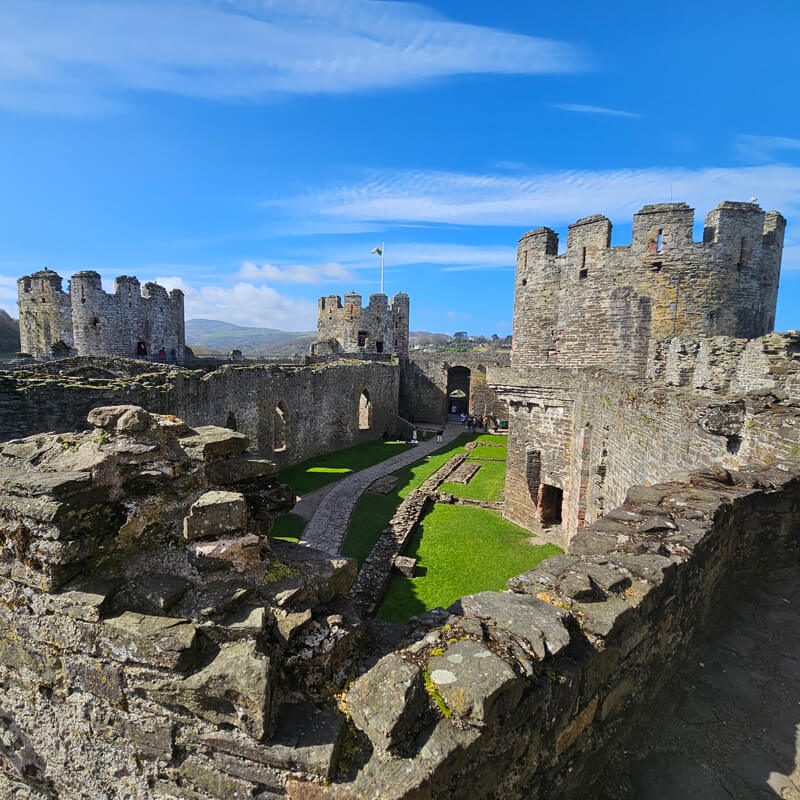
His answer included an ambitious programme of castle building, particularly in north Wales. Together, these fortresses became known as Edward I’s Ring of Iron, a network of strongholds designed to help maintain English control over the conquered territories.
Among the most famous are Beaumaris, Caernarfon, Conwy and Harlech, whose imposing walls and sophisticated defences remain powerful reminders of Edward’s ambitions. Other important strongholds, including Flint, Rhuddlan and Denbigh, also played roles in establishing and maintaining English control.
These castles were more than defensive structures. They served as military bases, centres of royal government and visible symbols of the new political order imposed on Wales.
Edward I’s conquest fundamentally changed the country’s political landscape, but it did not erase Welsh identity or the memory of independence. The castles he left behind remain among the most striking physical legacies of this turbulent period in Welsh history.
Discover more about Edward I’s Ring of Iron →
Did you enjoy this post?
I hope you found this post useful. I put a great deal of time and effort in to building, maintaining and populating the website. If you like, you could say a small thank you by buying me a coffee. You don't have to, but it would be nice :)
Buy me a coffee

Stay up to Date
Follow me on my journey and get notified whenever a new post is published by following Kings & Castles on Facebook.
Follow MeExplore The Map
Discover the hundreds of castles, churches, monasteries, cathedrals and other historic locations that I've personally visited across England and Wales. Search by location, explore nearby sites and plan your next historical adventure.
Share: