The Bretwaldas of Anglo-Saxon England
Bretwaldas were powerful Anglo-Saxon kings who were regarded as having authority or influence over several kingdoms of Anglo-Saxon England. The word Bretwalda appears in the Anglo-Saxon Chronicle and is often understood to mean something like “ruler of Britain” or “wide ruler.”
The Kings Named as Bretwaldas
The idea of the Bretwalda is closely connected with the Heptarchy, the traditional name for the seven major Anglo-Saxon kingdoms: Northumbria, Mercia, East Anglia, Essex, Kent and Wessex. These kingdoms frequently competed for territory, wealth and political influence. At different times, one particularly successful king could become the most powerful ruler among them – the Bretwalda.
Although the title was never an official position like the later title of King of England, it reflects the changing balance of power, and the term has come to describe rulers who achieved a position of supremacy or influence over other Anglo-Saxon kingdoms.
The Anglo-Saxon Chronicle names eight kings as Bretwaldas. The first seven had previously been identified by the historian Bede as kings who had exercised imperium, or authority, over other Anglo-Saxon kingdoms. The Chronicle later added Ecgberht of Wessex as the eighth. The word Bretwalda itself only appears in the surviving Anglo-Saxon sources in the Chronicle’s entry for 829.
Ælle of Sussex
The first ruler traditionally described as a Bretwalda was Ælle of Sussex, who lived during the late 5th or early 6th century. The Anglo-Saxon Chronicle identifies him as the first of the rulers who held supremacy over other Anglo-Saxon kings.
Very little reliable information survives about Ælle, and his dates and the extent of his territory are uncertain. Nevertheless, his position at the beginning of the Bretwalda tradition suggests that later Anglo-Saxon writers regarded him as an early example of a king exercising authority beyond his own kingdom.
Ceawlin of Wessex
Ælle was followed by Ceawlin of Wessex, who became one of the most powerful Anglo-Saxon rulers of the late 6th century.
Ceawlin fought several battles against the native Britons and other Anglo-Saxon groups and expanded the influence of Wessex into parts of southern England. His defeat in 592 marked the end of his period of dominance, and he was subsequently driven from power.
Ceawlin’s inclusion in the Bretwalda tradition reflects the growing importance of Wessex during the early Anglo-Saxon period.
Æthelberht of Kent
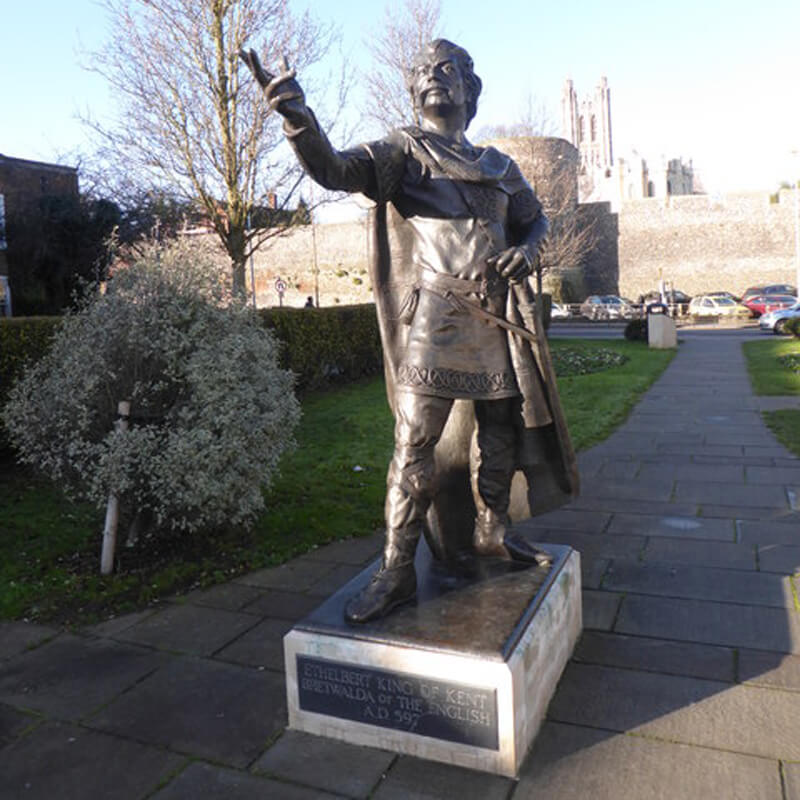
During the early 7th century, Æthelberht of Kent became one of the most influential kings in southern England.
Æthelberht was also one of the earliest Anglo-Saxon kings to adopt Christianity. His conversion was closely connected with the arrival of St Augustine’s mission in 597, while his marriage to Bertha, a Christian Frankish princess, strengthened Kent’s links with the Christian world.
His authority extended beyond Kent, although this was not the same as direct government over the other kingdoms. Instead, his position appears to have been based on political influence and supremacy over other rulers.
Æthelberht is also remembered for issuing one of the earliest surviving sets of written laws in Anglo-Saxon England.
Rædwald of East Anglia
The next ruler traditionally identified as a Bretwalda was Rædwald of East Anglia, who was active during the early 7th century.
Rædwald became involved in the political struggles of Northumbria and is believed to have played an important role in helping Edwin regain power. His position demonstrates that East Anglia could exert considerable influence over events far beyond its own borders.
Rædwald is also frequently associated with the magnificent Sutton Hoo burial, although the identity of the person buried there remains uncertain. The wealth and craftsmanship found at Sutton Hoo nevertheless provide striking evidence of the power and international connections of an early 7th-century East Anglian ruler.
Edwin of Northumbria
Edwin of Northumbria became one of the most powerful rulers in early 7th-century Britain.
His kingdom brought together the rival Northumbrian kingdoms of Deira and Bernicia, while Edwin also extended his influence over territories further south. His power was sufficiently great for Bede to regard him as one of the rulers who exercised authority over the southern kingdoms.
Edwin also converted to Christianity. His conversion was strongly influenced by his Christian wife, Æthelburg of Kent, and the missionary Paulinus, who had accompanied her to Northumbria.
Edwin’s period of dominance ended in 632 or 633 when he was defeated and killed at the Battle of Hatfield Chase by an alliance led by Cadwallon ap Cadfan of Gwynedd and Penda of Mercia.
Oswald of Northumbria
After Edwin’s death and a period of political upheaval, Oswald of Northumbria restored Northumbrian power.
Oswald defeated Cadwallon and reunited much of Northumbria. He was also a committed Christian and played an important role in the conversion of northern England. He invited missionaries from the monastery of Iona to establish a religious centre at Lindisfarne, which became one of the most important centres of Christianity in Anglo-Saxon England.
Oswald’s reign ended in 642 when he was defeated and killed by Penda of Mercia at the Battle of Maserfield.
Oswiu of Northumbria
Oswiu, Oswald’s brother, succeeded him as king of Bernicia and eventually became one of the most powerful rulers in 7th-century England.
His reign was dominated by the continuing struggle between Northumbria and Mercia. Oswiu eventually defeated and killed Penda of Mercia at the Battle of the Winwæd in 655, bringing an end to Penda’s long period of military dominance.
Following Penda’s death, Oswiu established Northumbrian control over Mercia for several years and exercised considerable influence over other Anglo-Saxon kingdoms. He is the seventh ruler in Bede’s earlier list of kings who exercised imperium, and consequently the seventh of the eight rulers later identified as Bretwaldas by the Anglo-Saxon Chronicle.
Oswiu was also an important figure in the development of Christianity in England. In 664 he presided over the Synod of Whitby, which addressed differences between the Northumbrian and Roman Christian traditions and helped establish Roman practices as the standard within the Northumbrian church.
Ecgberht of Wessex
The final ruler named as a Bretwalda was Ecgberht of Wessex, who became king in 802.
Ecgberht spent the early part of his reign strengthening Wessex before defeating the Mercians at the Battle of Ellandun in 825. His victory brought much of southern England under his influence and marked a major turning point in the decline of Mercian dominance.
In 829, Ecgberht defeated the Mercians and took control of their kingdom for a time. The Anglo-Saxon Chronicle records that he had conquered Mercia and all that was south of the Humber, and describes him as the eighth Bretwalda. He also received the submission of the Northumbrians.
Ecgberht’s victories helped establish Wessex as the leading Anglo-Saxon kingdom and laid important foundations for the eventual unification of England under his descendants.
The 150-Year Gap
There is a striking gap in the traditional list of Bretwaldas.
Oswiu died in 670, while Ecgberht did not become the eighth Bretwalda until 829 – almost 160 years later.
During those intervening years, some of the most powerful kings in Anglo-Saxon England ruled from Mercia, not Wessex or Northumbria.
This was the period that later historians have called the Mercian Supremacy. From the rise of Penda through the reigns of later Mercian kings, Mercia repeatedly exercised considerable authority over other kingdoms south of the Humber. The height of this power came during the long reigns of Æthelbald and Offa, when Mercian influence extended across much of southern England.
Yet none of these Mercian rulers appears in the traditional list of Bretwaldas.
This does not mean that the Bretwalda list was necessarily intended as a complete list of every Anglo-Saxon king who achieved supremacy over his neighbours. Bede’s original list was concerned with kings who had exercised imperium, while the Anglo-Saxon Chronicle later adapted that tradition and added Ecgberht.
Nevertheless, the long gap is important because it shows that the Bretwalda tradition cannot simply be treated as a chronological list of every ruler who dominated Anglo-Saxon England.
Powerful Kings Who Were Not Bretwaldas
Several powerful Anglo-Saxon kings are absent from the traditional Bretwalda list. The most important examples are Penda, Æthelbald and Offa of Mercia.
Together, their reigns demonstrate just how powerful Mercia became during the centuries between Oswiu and Ecgberht.
Penda of Mercia
Penda of Mercia was one of the most formidable rulers of 7th-century England.
A pagan king in an increasingly Christian political landscape, Penda successfully challenged the growing power of Northumbria. He was involved in the defeat and death of Edwin of Northumbria in 633 and later defeated and killed Oswald of Northumbria at the Battle of Maserfield in 642.
Penda’s victories helped establish Mercia as a major political and military power. He was eventually defeated and killed by Oswiu at the Battle of the Winwæd in 655.
Although Penda is not named as a Bretwalda, his military success and influence over other rulers make him one of the clearest examples of why the traditional list should not be regarded as a complete ranking of Anglo-Saxon power. Modern historians have also examined Penda’s reign as an important example of early Mercian overkingship.
Æthelbald of Mercia
More than sixty years after Penda’s death, Æthelbald of Mercia restored Mercian dominance over much of southern England.
Æthelbald ruled from 716 to 757 and became one of the most powerful Anglo-Saxon kings of the 8th century. By the time Bede completed his Ecclesiastical History in the early 8th century, he described the southern English kingdoms and their bishops as being subject to Æthelbald.
Æthelbald’s supremacy was not necessarily direct rule over every territory. Like other early Anglo-Saxon overlords, his authority depended upon military power, alliances and the submission of other rulers. Nevertheless, his position demonstrates the extent to which Mercia had become the dominant power south of the Humber.
Offa of Mercia
Offa of Mercia, who ruled from 757 to 796, took Mercian power to an even greater height.
During his reign, Mercia exercised considerable influence across southern England. Offa maintained diplomatic relations with Charlemagne, king of the Franks, and his authority extended far beyond the Mercian heartlands.
Offa is also remembered for Offa’s Dyke, the enormous earthwork constructed along much of the frontier between Mercia and the Welsh kingdoms.
The reigns of Æthelbald and Offa formed the high point of Mercian power. Together with the earlier rise of Penda and the achievements of other Mercian rulers, they demonstrate that the centuries between Oswiu and Ecgberht were not simply a period in which the idea of Anglo-Saxon overlordship disappeared. Instead, political supremacy had shifted decisively towards Mercia.
Why Were the Great Mercian Kings Not Bretwaldas?
The absence of Penda, Æthelbald and Offa from the Bretwalda tradition is one of the most interesting aspects of early English history.
The seven rulers originally identified by Bede were not described by him using the word “Bretwalda”. Bede instead wrote about kings who had exercised imperium over the southern Anglo-Saxon kingdoms. More than a century later, the Anglo-Saxon Chronicle reproduced Bede’s seven rulers and added Ecgberht after his conquest of Mercia in 829.
This creates a striking historical contrast.
The traditional sequence moves from Oswiu of Northumbria, who died in 670, to Ecgberht of Wessex, who became the eighth ruler in 829. Yet much of the period between them was dominated by Mercia.
The Mercian kings did not necessarily rule through a formal institution called the Bretwalda. Their power, like that of earlier overlords, depended upon military success, tribute, alliances and the submission of other rulers. There was therefore no established office that they had somehow been denied.
However, the sources themselves deserve consideration.
The Anglo-Saxon Chronicle was compiled in a West Saxon political context at a time when Wessex had become the dominant English kingdom. Modern historians have therefore noted that the Chronicle presents English history from a largely West Saxon perspective and gives relatively little attention to Mercia’s achievements during its period of supremacy. Cambridge scholarship has specifically noted the Chronicle’s essentially West Saxon viewpoint and the comparatively poor historical survival of Mercian achievements.
This does not prove that the Bretwalda list was deliberately created to erase Mercian kings from history. It is more accurate to say that the surviving tradition reflects the sources and political circumstances in which it was recorded.
The omission of Penda, Æthelbald and Offa therefore reminds us that the Bretwalda list should not be treated as an objective league table of the most powerful Anglo-Saxon kings.
From Bretwaldas to Kings of England
The story of the Bretwaldas represents an important stage in the development of England.
These rulers were not kings of a united England in the modern sense. Instead, they were kings who, at different times, achieved sufficient military strength, political influence or prestige to dominate other Anglo-Saxon kingdoms.
The balance of power shifted repeatedly between Northumbria, Mercia and Wessex. The history of the Bretwaldas therefore reflects a succession of competing centres of power rather than a straightforward progression towards a single English kingdom.
By the time of Ecgberht, Wessex had emerged as the leading power south of the Humber. His successors would take the process further.
Alfred the Great defended Wessex against the Viking invasions and established the foundations for the expansion of West Saxon power. His son Edward the Elder subsequently went on the offensive, extending his authority over much of the Danelaw and bringing Mercia increasingly under West Saxon control.
Under Æthelstan, Edward’s successor, this process reached a decisive stage. The separate Anglo-Saxon kingdoms were replaced by a much more unified English kingdom.
The Bretwaldas therefore represent more than a list of powerful early kings. They illustrate the changing centres of political power in Anglo-Saxon Britain — from Northumbria, to Mercia, and finally to Wessex — and the long, contested process through which those competing kingdoms eventually became England.
Did you enjoy this post?
I hope you found this post useful. I put a great deal of time and effort in to building, maintaining and populating the website. If you like, you could say a small thank you by buying me a coffee. You don't have to, but it would be nice :)
Buy me a coffee
Stay up to Date
Follow me on my journey and get notified whenever a new post is published by following Kings & Castles on Facebook.
Follow MeExplore The Map
Discover the hundreds of castles, churches, monasteries, cathedrals and other historic locations that I've personally visited across England and Wales. Search by location, explore nearby sites and plan your next historical adventure.
Share: