Edward I
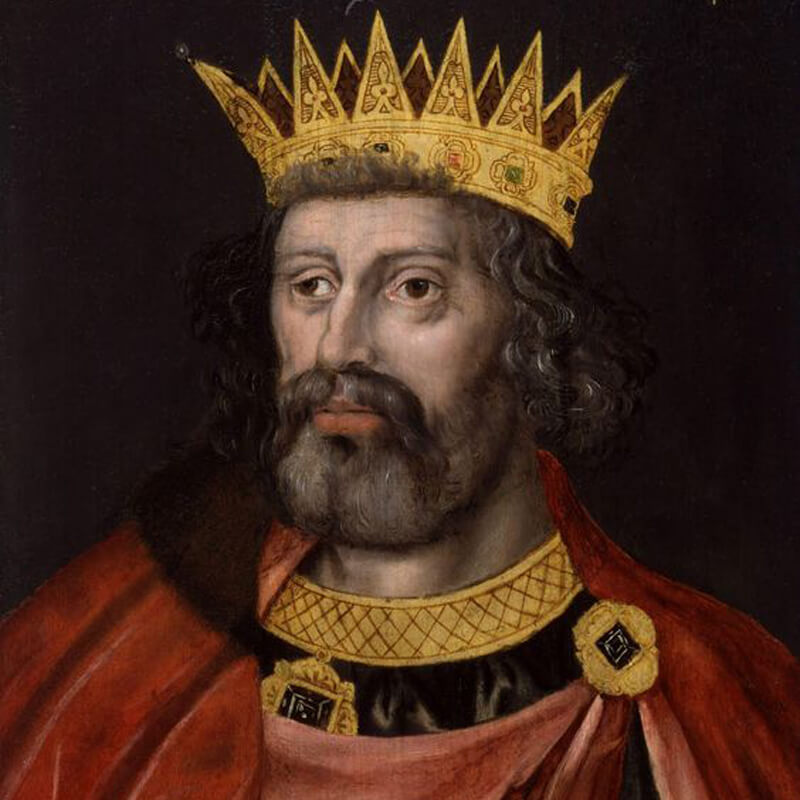
Edward I, also known as ‘Longshanks’ and ‘Hammer of the Scots’, was King of England from 1272 to 1307. Edward I is best known for conquering Wales, his brutal campaigns to subdue Scotland, and for building some of Wales’ biggest and best castles. Edward was a brave and fierce warrior king, but he was also a great reformer. He was responsible for significant legal and administrative reform in England, improving laws and made Parliament regular.
Quick
Facts.
- Born: 1239
- Died: 1307
- Reign: 1272 - 1307
- House: House of Plantagenet
- Predecessor: Henry III
- Successor: Edward II
Born in 1239 at the Palace of Westminster, Edward I was the first son of King Henry III and Eleanor of Provence. His father named him after the last Anglo-Saxon king (and his father’s favourite saint), Edward the Confessor. He was trained in knightly skills from a young age – hunting, horsemanship, sword, and lance. Edward also received a disciplined education – reading and writing in Latin and French, with training in the arts, sciences and music.
During Edward’s childhood, poor health was a big concern, however, Edward grew to be over six feet tall which was extremely rare for the time, earning him the nickname “Longshanks”, meaning “long legs”. At age 15, Edward’s father arranged a politically advantageous marriage to 13-year-old Eleanor of Castile to affirm English sovereignty over Gascony.
In 1254 Edward’s father gave him the duchy of Gascony, the Channel Islands, Ireland, lands in Wales, and the earldom of Chester, as well as several castles. Before his accession to the throne, he was commonly referred to as Lord Edward or Prince Edward.
Edward’s early adulthood took place against a backdrop of civil strife between his father and rebel barons in the Second Barons’ War. Edward and his father were held captive by rebel leader Simon de Montfort before Edward escaped and led royalist forces to victory at the Battle of Evesham in 1265, where Simon de Montfort was killed and Edward’s father was set free and restored to the throne. From this point, Edward took control of some aspects of the running of the kingdom from his weakened father, in some respects becoming his father’s regent.
By 1270 the country was sufficiently settled and Edward left England to join the French king Louis IX’s Eighth Crusade. However, when Louis IX died from dysentery before any significant fighting could happen, and failed to capture Tunis, the crusade was brought to a premature end. Edward decided to set sail for Acre on what is often referred to as Lord Edward’s Crusade, or sometimes called the Ninth Crusade, which is seen as an extension of the Eighth Crusade. This military expedition under the command of Edward was the last of the Crusades to reach the Holy Land before the fall of Acre in 1291, and brought an end to the permanent crusader presence there.
Edward landed in Acre in 1271, however, in 1272 when Edward arrived in Sicily, Edward received news of his father’s death and he had to abandon his crusade and return to England to be crowned. In the meantime, the country was governed by a royal council and Edward was proclaimed king in his absence. Over a year later, he finally made it to England and was crowned as King Edward I in August 1274 at Westminster Abbey. Becoming king aged 35 years old, he was a veteran warrior, a leader with energy and vision, and with a formidable temper.
Edward’s reign had two main phases. The first phase was the administration of a now peaceful country. His first concern was to restore order and re-establish royal authority after the disastrous reign of his father. Edward reformed English Parliament and made it a permanent feature of English political life. A House of Commons had been created which was made up of wealthy members. Edward I became well-known during his reign for his contributions to reforms and developments in administration. He encompassed medieval kingship in all its forms, serving as an administrator, soldier and a man of religious conviction.
Much of Edward’s motivation for developing a form of government in the way that he did was based on raising the necessary funds in order to wage wars. Some of these included warring with neighbours across the Channel, and with Wales which was a thorn in Edward’s side. France also happened to be a strong ally of Scotland, which was another thorn in Edward’s side.
The second phase was warfare against Wales and Scotland. Edward was determined to enforce English kings’ claims to primacy in the British Isles. He didn’t want to rule just England, he also wanted to rule Wales and Scotland and felt that it was his right.
The first part of his reign was dominated by his campaigns in Wales. In 1277 Edward invaded Wales, defeated the Welsh leader and Prince of Gwynedd, Llywelyn ap Gruffudd, and built a ring of castles to enforce his authority, which have since been termed the “Ring of Iron“, the most notable being Beaumaris, Caernarfon, Conwy and Harlech. A Welsh rebellion broke out in 1282 led by Llywelyn’s son Dafydd, but Lywelyn was lured into a trap and killed at the Battle of Orewin Bridge. Edward’s conquest was complete with the capture of Llywelyn’s son Dafydd in 1283, who was taken to Shrewsbury and executed as a traitor the following year.
Edward I ended Welsh hopes of independence and Wales was brought into the English legal and administrative framework. Edward embarked on a full-scale project of English settlement of Wales and created new towns like Flint, Aberystwyth and Rhuddlan, and in 1301 Edward’s son, Edward of Caernarfon (later Edward II), born at Caernarfon Castle, was proclaimed Prince of Wales – a tradition that persists to this day.
After Edward’s conquest of Wales, he turned his attention to Scotland. Scotland and England were at peace in the 1280s with King Alexander III of Scotland paying homage to Edward, who was his brother-in-law. Intermarriage between the English and Scottish royal houses promoted peace between the two countries. However, problems arose with the Scottish succession crisis of the early 1290s when King Alexander died prematurely in 1286. Alexander’s death was the precursor to the events that lead to a war which would overshadow the rest of Edward’s reign in what was to become known as the ‘Great Cause’.
The heir to the throne of Scotland was Alexander’s infant granddaughter Margaret the ‘Maid of Norway’, she was the daughter of the King of Norway and Alexander’s sole surviving descendant. Edward planned to wed his own then only surviving son, Edward of Caernarfon to Margaret and thus control Scotland via matrimonial rights. Unfortunately, the young Margaret also died prematurely in 1290. This left Scotland without a monarch, which started all the problems.
Also in 1290, Edward’s wife Eleanor of Castile died. Unusual for arranged marriages, the couple actually loved each other and Edward was deeply affected by her death. Edward and Eleanor had many children, perhaps as many as 16. Of these, five daughters survived into adulthood, but only one boy survived – his son and heir Edward, Prince of Wales. Edward married his second wife in 1299 – the French princess Margaret, and together they had three children; one daughter and two sons.
Meanwhile, in Scotland, with a succession crisis looming and rival claimants in fierce competition, the Guardians of Scotland needed to find someone to adjudicate the claims and help break the deadlock. The perfect candidate was Edward. As an internationally respected king and a recognised expert on legal matters of state Edward was a logical choice, and in 1292 Edward was asked to arbitrate in the succession dispute. There were many claimants, but the two main rival claimants were John Balliol and Robert de Brus (the grandfather of the famous Robert the Bruce). Edward nominated John Balliol as king, who swore allegiance to him.
However, Edward’s unfair demands, his desire for English overlordship over Scotland and feudal supremacy, and his heavy-handed treatment of the Scots, such as demanding taxes and soldiers to help fight his wars, pushed the Scots into an alliance with France which led to the first of the Scottish rebellions. During the years of the Scottish arbitration Edward had slowly been drifting into war with France, who had been attempting to confine Edward’s power in his duchy of Gascony. The alliance that Scotland made with Edward’s enemy across the Channel brought about swift retaliation from Edward, and he invaded and conquered Scotland.
Edward successfully invaded and conquered Scotland in 1296. He confiscated the Stone of Destiny (the Scottish coronation stone, also known as the Stone of Scone) and brought it to Westminster, deposed John Balliol and placed him in the Tower of London, and installed Englishmen to govern the country. It is in this period he earned his nickname, “Hammer of the Scots”. His campaign in Scotland had been very successful, but his triumph would only be temporary.
By 1297, Edward’s campaigning in France, Scotland and Wales had left him seriously short of funds. He could no longer afford to build costly castles to control his new domain as he had in Wales. Edward’s commitments massively outweighed his resources and his debts were constantly rising. Parliament was reluctant to contribute to Edward’s expensive military policies, and Edward was forced to reconfirm the Charters (including Magna Carta) to obtain the money he required.
In Scotland, opposition gathered around William Wallace, a warlord from one of the notable families, and a rebellion soon broke out. Wallace was initially successful, defeating a large English force at Stirling Bridge in 1297. But in 1298 Edward defeated Wallace at the Battle of Falkirk, and Wallace escaped into the mountains to continue fighting.
Edward’s next move was political. In 1303 a peace treaty was made between England and France, under which the French king restored the duchy of Gascony to Edward, while also breaking up the Franco-Scottish alliance. Robert de Brus and most of the other nobles pledged allegiance to Edward, and William Wallace was betrayed. Wallace was captured and handed over to the English in 1305, taken to London, tried for treason and was publicly executed by being hanged, drawn and quartered.
Robert de Brus died in 1304, and in 1306 his ambitious son, Robert the Bruce rebelled by killing a fellow counsellor, his rival John Comyn, and was crowned king of Scotland. Edward, at this point in ill health, sent his armies north to suppress the rebellion. With a series of swift victories, Robert the Bruce was defeated at the Battle of Methven and the new King of Scots was on the run. Edward followed with brutal suppression of the allies of Robert the Bruce, which fuelled more rebellions. Within a year Robert the Bruce had defeated larger English forces and regained control of swathes of Scotland. A minor rebellion had become a sizeable rising.
Edward had finally met a formidable, ruthless and determined opponent in Robert the Bruce – a man cut from the same cloth. The conflict was still in progress in 1307 when Edward, now an elderly man, led his final campaign into Scotland before dying at Burgh-on-Sands on his way to rid himself of Bruce once and for all at age 68, leading to the succession of his son, the Prince of Wales, as Edward II of England. The campaign for the conquest of Scotland passed on to his son, and the Scots were relieved to find that the brutal and effective military prowess displayed by the father were absent in the son.
According to chroniclers, Edward I requested that his bones be left unburied as long as Scotland was unconquered, that they should be carried on Scottish campaigns and that his heart be taken to the Holy Land. Instead, Edward was buried at Westminster Abbey in a marble tomb, and written on his tomb are the words “Hammer of the Scots. Keep the Faith”.
Edward I was arguably one of England’s greatest kings (and Scotland’s greatest enemy). He was to be remembered as a pompous, but influential and imposing figure who made decisions, both good and bad, which shaped the country for years to come. Described as tall and handsome, he was a tough, brave warrior king. He is personally one of my favourite English kings, but only because he built my favourite castles – the biggest and most imposing castles in Wales.
Did you enjoy this post?
I hope you found this post useful. I put a great deal of time and effort in to building, maintaining and populating the website. If you like, you could say a small thank you by buying me a coffee. You don't have to, but it would be nice :)
Buy me a coffee
Stay up to Date
Follow me on my journey and get notified whenever a new post is published by following Kings & Castles on Facebook.
Follow MeExplore The Map
Discover the hundreds of castles, churches, monasteries, cathedrals and other historic locations that I've personally visited across England and Wales. Search by location, explore nearby sites and plan your next historical adventure.
Share: