Edward IV
Edward IV was King of England from 1461 to 1470, then again from 1471 until his death in 1483. He was a central figure in the Yorkist-Lancastrian conflict known as the Wars of the Roses, a series of civil wars in England fought between the Plantagenet cadet houses of York and Lancaster between 1455 and 1487. Edward IV and the Yorkists eventually won the struggle against the Lancastrians and established the House of York on the English throne.
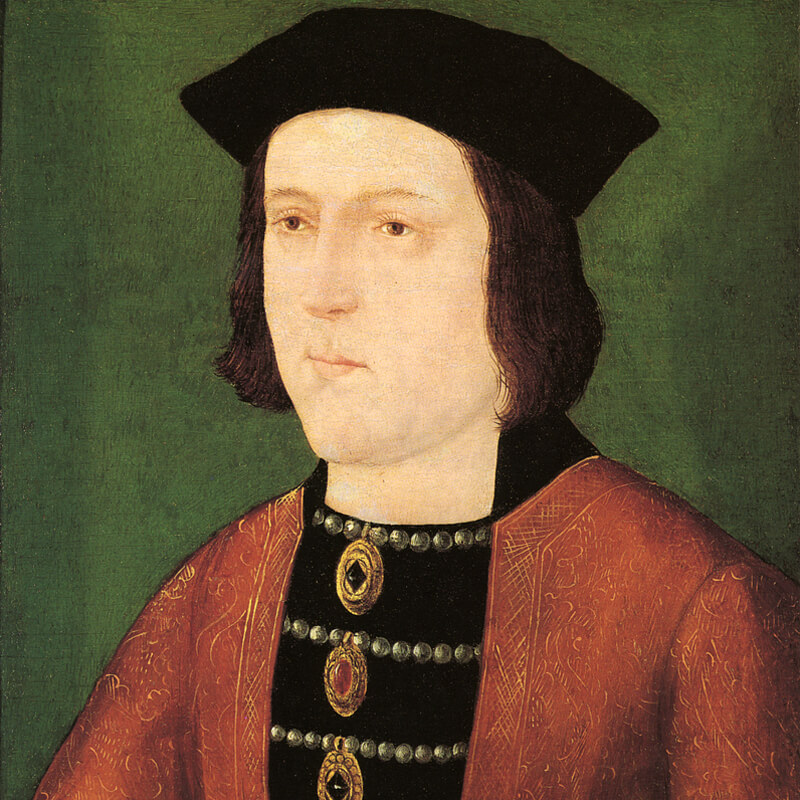
Quick
Facts.
- Born: 1442
- Died: 1483
- Reign: 1461 - 1470 & 1471 - 1483
- House: House of Plantagenet
- Predecessor: Henry VI
- Successor: Edward V
Early Life
Edward IV was born in 1442 in Rouen, Normandy, France. He was the eldest surviving son of Richard Plantagenet, Duke of York, and Cecily Neville, daughter of Ralph Neville, earl of Westmorland. Both his parents were direct descendants of King Edward III, giving Edward a potential claim to the throne. Edward’s brothers, who would all be involved in the dynastic conflict known as the Wars of the Roses, were Edmund, Earl of Rutland, George, Duke of Clarence, and Richard, Duke of Gloucester (the future Richard III). Until his father’s death, Edward was known as the Earl of March, and by the age of 17 he was already a political and military leader in his own right.
Edward’s family belonged to the House of Plantagenet, and his ancestors had sat on the English throne since 1154. However, the house of Plantagenet had split into two opposing factions; the House of Lancaster and the House of York, both keen to claim the throne for themselves. The Lancastrian line had ruled since 1399, but Henry VI‘s weak rule and subsequent mental illness prompted Edward’s father, as a descendent of Edward III via the Yorkist line, to pursue his own claim to the throne in 1455.
Edward’s cousin, King Henry VI of the House of Lancaster, sat on the throne of England but was mentally unstable and proved to be a weak ruler, and Edward and his father believed that they had a better claim to the throne. In the 1450s, Henry VI suffered a series of mental breakdowns and severe depression. Henry collapsed mentally and physically, unable to speak and unable to rule, so in 1454 after months of crisis Edward’s father, the Duke of York, became Protector of the Realm.
Mounting Tensions
Tensions mounted between Henry’s queen, Margaret, and the Duke of York over control of the incapacitated King’s government, which developed into a major dispute over the succession to the English throne. It was at this time when a fierce rivalry and a jostling for power developed between the two houses which created deep animosity, and when Henry temporarily recovered in 1455 Richard was dismissed from his role as Protector of the Realm and replaced with a rival Lancastrian.
Richard’s opposition to the Lancastrians was the cause of the famous civil wars between the two houses, known as the War of the Roses. The Yorkists and the Lancastrians began to prepare for battle, recruiting soldiers and making preparations for war, with supporters choosing either a Red Rose to represent the House of Lancaster or a White Rose for the House of York.
The Wars of the Roses Begins
Richard led a revolt against the king, and the first battle of the civil war took place on 22nd May 1455 at St Albans, led by Richard and his powerful ally Richard Neville, Earl of Warwick, also known as the ‘Kingmaker’. This marked the start of the War of the Roses. Edward’s father regained control of the government, briefly becoming Protector again and attempted to assert his legitimate claim to the throne, but he was unable to command sufficient support among the nobility.
After five years of civil war between the Lancastrian and Yorkist factions, with a great loss of life on both sides, Henry VI was captured at the Battle of Northampton in July 1460 and imprisoned in the Tower of London, and Queen Margaret fled to Wales. Now a prisoner, Henry was effectively their puppet king, and in October 1460 he was forced to accept the Act of Accord which disinherited his own son in favour of Edward’s father.
Edward’s First Reign as King
Shortly after in December 1460, Edward’s father was killed at the Battle of Wakefield alongside Edward’s brother, Edmund. Edward, who was an able commander, inherited his father’s claim and took up the fight. Now Edward, the new duke of York, was the leader of the Yorkist forces and he was after both the throne and revenge for his father’s death. With the support of the powerful Earl of Warwick (the Kingmaker), Edward defeated the Lancastrians in a series of battles, culminating in the Battle of Towton in 1461, when Henry VI was overthrown and Edward was crowned King Edward IV on 28th June 1461. Henry, Margaret and their son Edward fled to Scotland, and Edward remained on the throne for the next nine years.
Henry and his family returned to England in 1464 to support an unsuccessful Lancastrian rising, but Henry was captured by Edward’s forces in 1465 and imprisoned in the Tower of London. The Earl of Warwick (the Kingmaker) believed he could control Edward, and he was keen to negotiate a foreign marriage for him, but in 1464 Edward secretly married Elizabeth Woodville, a commoner and widow of a Lancastrian supporter.
Edward is Deposed
Warwick the ‘Kingmaker’ was furious by Edward’s decision and switched his allegiance to the Lancastrians. Edward’s younger brother George, Duke of Clarence, was also recruited to the cause when Warwick promised him that he would be next in line to the throne after Henry VI’s son, should he support the Lancastrians against his brother. Warwick and Clarence became allies and fled to France, where they joined Margaret of Anjou, wife of Henry VI. They then led a revolt against the king, and Margaret’s Lancastrian army invaded England in September 1470. However, Warwick had his own agenda for the throne and after marrying his daughter to Henry VI’s son he managed to overthrow his fellow Yorkists with the support of Margaret’s army, allowing Henry to reclaim the throne in October 1470. But the weak king allowed Warwick to essentially rule on his behalf.
Edward fled to the Continent with his brother Richard, Duke of Gloucester, where the Duke of Burgundy, Charles the Bold, sided with Edward and provided the support he needed to reclaim his throne. Edward returned to England in March 1471 with the support of Charles, his brother Richard, Duke of Gloucester and his brother George, Duke of Clarence (who decided to become loyal to him once more). Edward defeated and killed Warwick at the Battle of Barnet in April 1471 before defeating the Lancastrians and killing Henry’s son and heir, Edward of Westminster, at the Battle of Tewkesbury in May, and shortly afterwards Henry VI was put to death in the Tower of London.
Edward’s Second Reign as King
Edward took the throne for the second and final time in 1471 and remained king of England and the first Yorkist king until his death in 1483. Edward’s restoration to the throne meant that he became only the second British Monarch to sit on the throne twice, the first being of course his predecessor and cousin Henry VI. Despite facing an overseas threat from Henry Tudor (the future Henry VII), the last remaining Lancastrian claimant, the second part of Edward’s reign was a period of relative peace and security.
Edward was by no means the perfect King, he was known to misjudge a number of political situations, particularly in relation to his deceitful rival the French King, Louis XI, with whom he almost reignited the Hundred Years’ War with in 1475, but instead they formed a treaty that formally ended the Hundred Years’ War. Edward’s greatest achievement as King was to restore a sense of order to a country and government which had lost its sense of purpose during the chaotic days of Henry VI’s rule.
Not only was Edward a successful military commander, he was also flourishing businessman who had invested in many successful ventures. He sacked Lancastrian office-holders and used his financial acumen to introduce tight management of royal revenues to reduce the Crown’s debt. He encouraged overseas commercial treaties, improved law enforcement, built St George’s Chapel at Windsor, and introduced a time of prosperity and success to the realm.
But what of Edward’s treacherous younger brother George of Clarence? Having realised his mistake and rejoining his brothers Edward and Richard to defeat the Lancastrians at the Battle of Barnet, he was nevertheless tried for treason against the restored King and was executed in private at the Tower of London on 18th February 1478. However, there is a widely held belief that George was drowned in a casket of wine (also purported to be true by Shakespeare in his plays Henry VI and Richard III), thought to be a humorous reference to the fact that George was fond of a drink or two.
The Death of Edward IV
Edward IV and his wife Elizabeth Woodville had several children, and when Edward died in 1483 as a result of an undiagnosed illness, he left his 12-year-old son Edward V to succeed him, although he would only reign for a very brief three months, and the Yorkist dynasty would outlive Edward for just two short years. His young sons, Edward V and his younger brother Richard of Shrewsbury would become part of a murder mystery known as ‘The Princes in the Tower‘. Young Edward and Richard were left in the protection of their uncle Richard, Duke of Gloucester, who housed them in the Tower of London where they famously disappeared without a trace, probably murdered on their uncle’s orders. As a result, Parliament requested that Richard take the throne, which he accepted, being crowned Richard III.
Richard III was killed by Henry Tudor at the Battle of Bosworth in 1485, making him the last Yorkist king and also the last of the Plantagenet kings, as Henry Tudor took the throne as King Henry VII. Henry Tudor was a Welsh claimant of distant relation to Edward III and son to Henry VI’s half brother Edmund, who became the last British King to claim the throne on the battlefield. To appease his predecessors Henry VII married Edward IV’s eldest daughter, Elizabeth of York, uniting the houses of York and Lancaster. This unification of the houses finally brought an end to the Wars of the Roses, and so began the reign of the infamous house of Tudor, who continued to rule England and Wales for the next 117 years.
Did you enjoy this post?
I hope you found this post useful. I put a great deal of time and effort in to building, maintaining and populating the website. If you like, you could say a small thank you by buying me a coffee. You don't have to, but it would be nice :)
Buy me a coffee
Stay up to Date
Follow me on my journey and get notified whenever a new post is published by following Kings & Castles on Facebook.
Follow MeExplore The Map
Discover the hundreds of castles, churches, monasteries, cathedrals and other historic locations that I've personally visited across England and Wales. Search by location, explore nearby sites and plan your next historical adventure.
Share: