Elizabeth of York
A daughter of a king, sister to a king, the niece of a king, wife to a king, mother to a king, and grandmother of a king & queens. Elizabeth of York was the Queen of England from her marriage to King Henry VII from 1486 until her death in 1503. Her marriage to Henry VII unified the waring houses of York and Lancaster at the end of the Wars of the Roses.
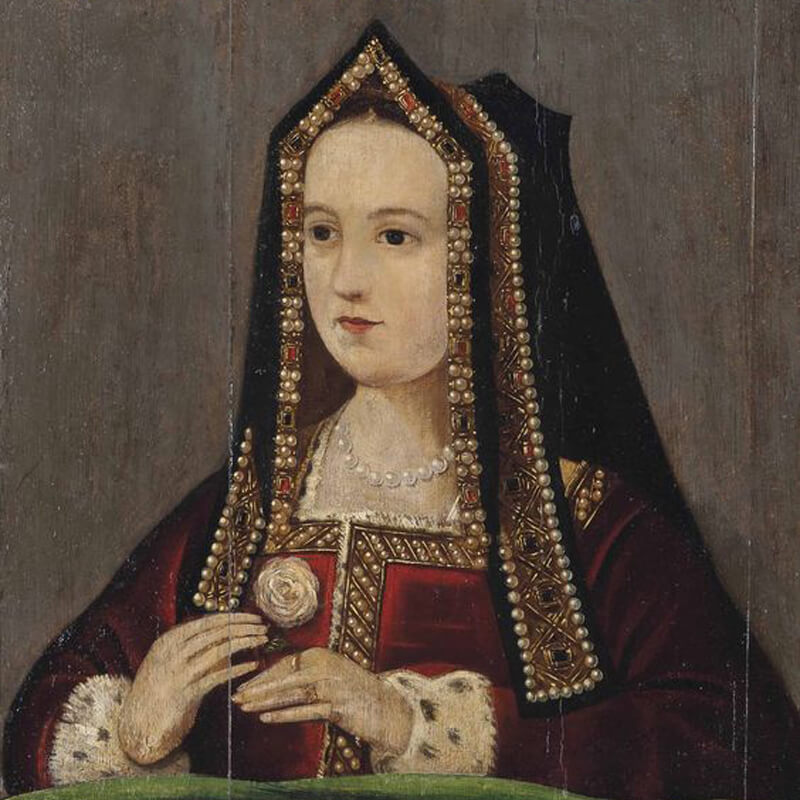
Elizabeth of York was the eldest child of King Edward IV and Elizabeth Woodville, born at the Palace of Westminster on 11th February 1466 during the Wars of the Roses. She had younger sisters and two younger brothers; Edward (the future Edward V) and Richard. In April 1483, Elizabeth’s father, King Edward IV, unexpectedly died and her younger brother Edward V ascended to the throne.
Elizabeth’s uncle Richard, Duke of Gloucester (the future Richard III), was appointed regent and protector of his nephews. However, Richard quickly took steps to isolate his nephews from their Woodville relations, and their influence, including their own mother. Elizabeth and her siblings were declared illegitimate by the Act of Titulus Regius, and Richard took the throne as Richard III in July 1483.
Elizabeth’s young brothers disappeared inside the Tower of London and they were never seen again, likely murdered by their uncle, Richard III. They would become known to history as ‘The Princes in the Tower‘. Meanwhile, Elizabeth and her sisters were in sanctuary with their mother at Westminster Abbey. Rumours spread that Richard III was planning to marry Elizabeth himself.
Elizabeth’s mother, in secret correspondence with Margaret Beaufort, agreed to the marriage of Elizabeth to Margaret’s son, the exiled heir to the House of Lancaster, Henry Tudor, Earl of Richmond (the future Henry VII).
Henry Tudor defeated Richard III at The Battle of Bosworth and was crowned King Henry VII in October 1485. Three months later, Henry VII married his York Princess in January 1486, uniting the houses of York and Lancaster. Their first son, Arthur, was born on 20th September 1486, eight months after their marriage.
Elizabeth of York was crowned queen on 25th November 1487. As the eldest daughter of King Edward IV with no surviving brothers, Elizabeth of York had a strong claim to the throne in her own right, however Elizabeth would never rule as Queen Regnant. The rule of a queen regnant would not be accepted in England for another 67 years until the ascension of Elizabeth’s granddaughter, Mary I.
Despite being a political arrangement, the marriage proved successful, and both Henry and Elizabeth appeared to have genuinely cared for each other. Elizabeth gave birth to several more children, but only four survived infancy: Arthur, Margaret, Henry and Mary.
On 14th November 1501, Henry and Elizabeth’s 15-year-old son Arthur, married the young Spanish Princess Katharine of Aragon. The pair were sent to Ludlow Castle, the traditional residence of the Prince of Wales. However, Prince Arthur died in April 1502, most likely of the sweating sickness that was ravaging the area at the time. His heart is supposedly buried at St Lawrence’s Church in Ludlow. Elizabeth and Henry were distraught at the loss of their eldest son and heir.
The death of Arthur left the couple with only one male heir to the Tudor throne; the young Prince Henry, Duke of York (the future Henry VIII), so the couple decided to try for another son. They had another child, a girl named Katherine, born on 2nd February 1503 at the Tower of London, however she died on the same day. Tragically, Elizabeth of York died nine days later, dying of a post-pregnancy infection on her 37th birthday.
Her body was removed from the chamber where she died and taken to the chapel within the Tower. Underneath where she lay in state were the possible bodies of her younger brothers, Edward V and Richard Duke of York; they would be discovered nearly two centuries later.
Her family seems to have been devastated by her death, and mourned her deeply. According to one biographer, the death of Elizabeth “broke the heart” of her husband and “shattered him.” Elizabeth was buried at Westminster Abbey. Her magnificent effigy, which lies beside that of her husband, can still be seen in the Henry VII Chapel at Westminster Abbey today.
Did you enjoy this post?
I hope you found this post useful. I put a great deal of time and effort in to building, maintaining and populating the website. If you like, you could say a small thank you by buying me a coffee. You don't have to, but it would be nice :)
Buy me a coffee
Stay up to Date
Follow me on my journey and get notified whenever a new post is published by following Kings & Castles on Facebook.
Follow MeExplore The Map
Discover the hundreds of castles, churches, monasteries, cathedrals and other historic locations that I've personally visited across England and Wales. Search by location, explore nearby sites and plan your next historical adventure.
Share: