The Anglo-Saxon Burh
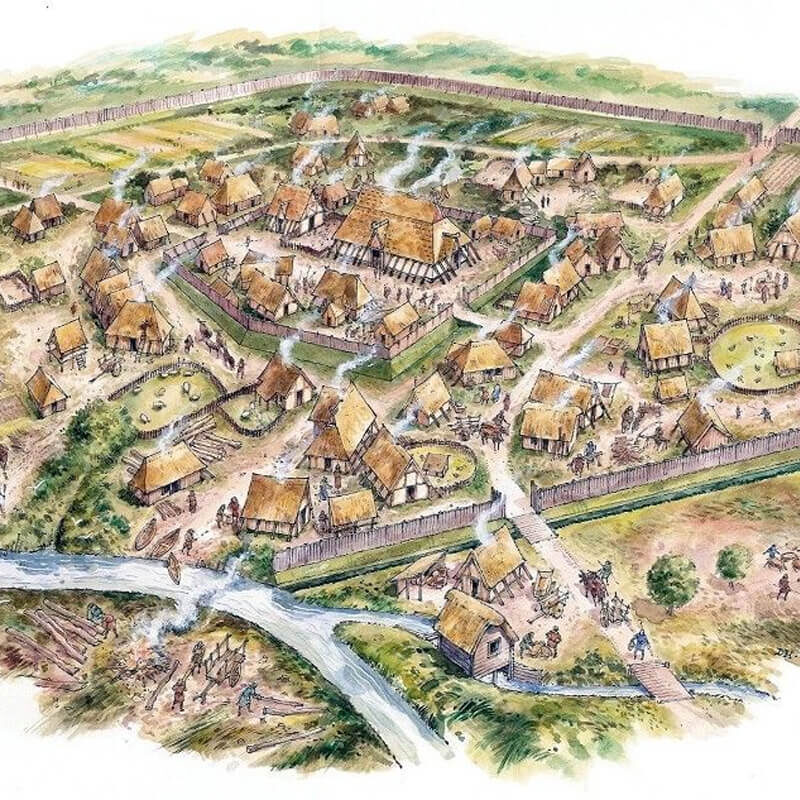
In the 9th century, in response to the threat of Danish invasion, King Alfred the Great created a series of fortified settlements known as burhs. This network of Anglo-Saxon burhs defended urban areas that were characterised by a planned, ordered layout, sometimes including a regular grid of streets.
The Creation of the First Burhs
Alfred the Great was known as “the great” for a reason. One of our greatest and most successful kings, he successfully suppressed Danish invasions, he established the Danelaw, he was the first to translate books from Latin into English, he founded the very first English navy, he gave birth to the idea of a unified England, and he created the burh.
In the year 878, King Alfred’s army defeated the Danes led by the Danish king Guthrum at the battle of Edington, and Wessex emerged as the dominant kingdom in England. Alfred brokered a peace treaty with the Danes and split the country in half; the northern and eastern parts of England were settled by the Danes, known as the Danelaw, and the rest of England would be controlled by the Anglo-Saxons. However, the Danish threat remained, so Alfred reorganised the Wessex defences, staring with the organisation his royal army known as “the fyrd”. He then started a building programme of well-defended settlements across southern England known as burhs. These burhs were fortified towns, and this is where we get the word ‘borough’ from today; borough comes from the Old English burh, meaning fortress.
The Purpose of a Burh
Burhs would be used as supply depots for the Anglo-Saxon army when it was in the field, thus ensuring that the Anglo-Saxon troops had a continual supply of weapons, fresh horses and food.
Centred round Alfred’s royal palace in Winchester, this network of burhs with extra defences on the main river routes meant that no part of Wessex was more than 20 miles from the refuge of one of these settlements. Together with a new fleet of fast ships built on Alfred’s orders, southern England now had a strong defence against the Danes. It is this fleet of ships that would be the start of what would become the British Royal Navy many centuries later.
Burhs became an important source of income for the king, people selling products of a certain value had to trade out of burhs, and this way the king could collect trade tax.
Burh Locations and Construction
The idea was to have burhs close enough to each other to be able to come to each others assistance in times of need, and also be so well defended that people from the area could rush to them in times of danger and be confident they would be protected. As a result, the burhs were places of safety in the countryside.
Burhs were gradually built over southern and western England as the Saxons took back more land from the Danes. The greatest concentration of burhs were built within the Anglo-Saxon kingdoms of Wessex and Mercia, and they clustered in areas with favoured royal residences such as Somerset and Wiltshire.
Some burhs were entirely new constructions built on strategic sites on the coast, near ports or overlooking roads and trade routes. But some burhs were made within existing fortifications and situated at the site of Iron Age hillforts or Roman forts, which used materials from the original fortifications.
During King Alfred’s reign there was the royal fyrd (royal army) and those of the local fyrd (local defence force). The local fyrd were responsible for the construction and defence of their burh, whereas members of the royal fyrd served under the king.
Burhs were made in a variety of different ways, depending on the materials available locally, and the size of the area it was intended to defend. The largest burhs would have taken more than 100,000 man hours to build.
Frequently, burh defences were either restored Roman town walls, or reused hillforts which utilised old ditches and ramparts.
A typical large and well-built burh would either be a round, square or rectangular layout, built on a raised earth mound with earthen ramparts around it, topped by strong timber walls known as palisades, or a restored Roman wall, with defensive towers dotted around the wall. Some were surrounded by a moat at the base. Entry would usually be via a defended main gatehouse, and sometimes another one or two smaller defended gatehouses at different points along the perimeter wall.
What Was Inside a Burh?
Most buildings within a burh, including churches, dwellings and outbuildings, were simple timber structures. Although their primary purpose was for defence, burhs also had a secondary role as commercial and sometimes administrative centres, safe areas in which trade and production could take place. Many larger burhs had their own markets, and some even became important enough to mint their own coins. Armouries, blacksmiths, royal mints and trading posts were all located within the burh.
Burhs After Alfred the Great
Many of the burhs were founded by Alfred the Great, but after his death, his careful plan of these defensive towns was continued by his son, Edward the Elder, his daughter, Æthelflæd, the Lady of the Mercians, and her husband, Æthelred, Ealdorman of Mercia. The Mercian Register tells of the building of ten burhs by Æthelflæd, including Tamworth and Stafford.
King Æthelstan, son of Edward the Elder and grandson of Alfred the Great, granted burhs the right to mint coinage, and in the 10th and 11th centuries the rule was that no coin was to be struck outside of a burh.
A 10th-century document known as the Burghal Hidage lists over 30 burhs, the majority being in the ancient Kingdom of Wessex, and the taxes (recorded as numbers of hides) assigned for their maintenance.
By 1060, London and York were Englands biggest towns with over 10,000 people in each, and by 1066, about 10% of the population lived in burhs.
Only eight of the burhs achieved municipal status in the Middle Ages: Chester, Bridgnorth, Tamworth, Stafford, Hertford, Warwick, Buckingham and Maldon. The largest were at Winchester, Wallingford and Warwick.
The Burghal Hidage
One of the most important sources for understanding the Anglo-Saxon burh is a document known as the Burghal Hidage. Compiled in the early 10th century, it records a network of fortified settlements established to help defend the Kingdom of Wessex against Viking attacks. Although closely associated with the defensive reforms of Alfred the Great, the document reflects a system that continued to develop under his son, Edward the Elder.
The Burghal Hidage lists more than 30 fortified places and records the number of hides assigned to each. A hide was a unit of land assessment used to calculate the resources a community was expected to provide, including military service. These assessments helped determine the manpower needed to maintain and defend each burh, linking local communities to the wider defence of the kingdom.
The network included important settlements such as Winchester, Oxford and Wallingford. Some burhs made use of existing Roman town walls, while others were defended by earthworks, ditches and timber fortifications. Together, they provided strategically positioned strongholds where troops could be stationed and local people could seek protection during periods of attack.
The Burghal Hidage offers a valuable glimpse into how Anglo-Saxon rulers organised their defences and mobilised resources across a kingdom. It also helps historians understand the growth of fortified settlements that, in some cases, developed into important towns and cities in later centuries.
Burhs Today
Burhs are widely thought to have been the origins of urban life in England. Wallingford and Wareham are the best-preserved examples of an Anglo-Saxon burh, with substantial ditches and banks still visible. Burhs also usually had regular street layouts, and some of our modern streets follow the same Saxon street plan, including Winchester, Chichester and Wallingford.
Did you enjoy this post?
I hope you found this post useful. I put a great deal of time and effort in to building, maintaining and populating the website. If you like, you could say a small thank you by buying me a coffee. You don't have to, but it would be nice :)
Buy me a coffee
Stay up to Date
Follow me on my journey and get notified whenever a new post is published by following Kings & Castles on Facebook.
Follow MeExplore The Map
Discover the hundreds of castles, churches, monasteries, cathedrals and other historic locations that I've personally visited across England and Wales. Search by location, explore nearby sites and plan your next historical adventure.
Share: