The Anglo-Saxon Chronicle
The Anglo-Saxon Chronicle is a collection of annals written primarily in Old English, arranged by year, chronicling the history of Anglo-Saxon and Norman England between the 9th and 12th centuries.
Overview
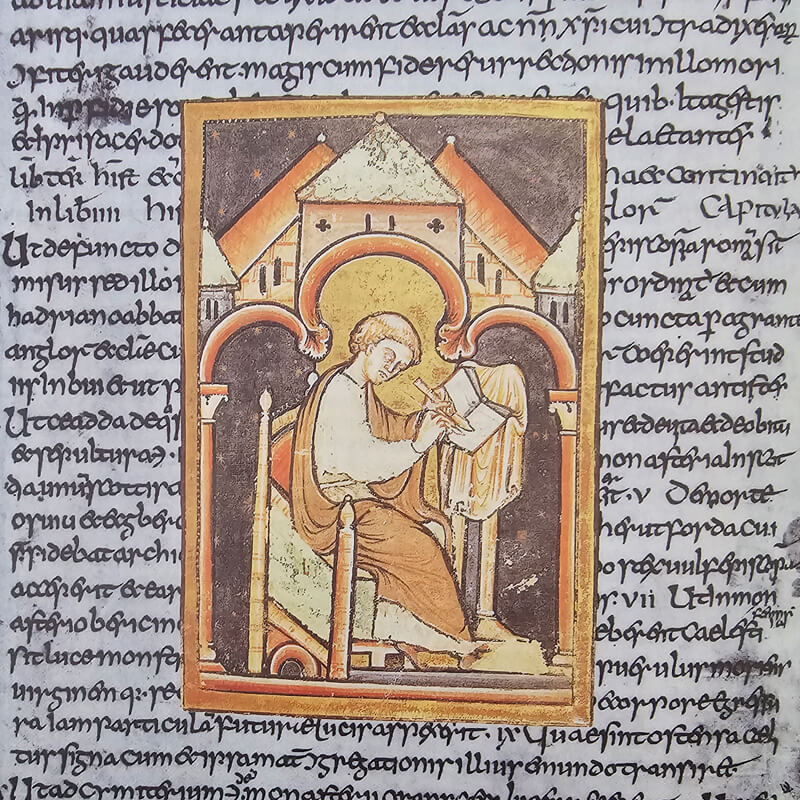
The Anglo-Saxon Chronicle was originally compiled on the orders of King Alfred the Great of Wessex, compiled at various English monasteries and added to by generations of anonymous authors. With a bias towards the Wessex dynasty, it is a series of annalistic chronicles that narrates the history of England from the early Anglo-Saxons until the bitter civil war known as ‘the Anarchy‘ and the coronation of Henry II in 1154.
The Anglo-Saxon Chronicle reveals information on a huge variety of subjects, including the Romans, the trials and tribulations of kingship, major battles and Viking invasions, famines and agricultural issues, the development of Christianity, Anglo-Saxon culture, notes on the death of notable people from across Britain and much more. It was the first of its kind and drew on other earlier sources to enhance its narrative such as smaller annals and work from the Venerable Bede in order to compile a detailed manuscript.
Its original manuscript was intended to be a national chronicle of events giving a detailed yearly account of English history. Soon after the year 890 multiple copies of the original chronicle were being circulated, distributed to monasteries across England where they were updated individually. These manuscripts were often enhanced and supplemented by each individual monastery leading to variations, whilst the Chronicle itself continued to grow for another hundred years.
These manuscripts collectively are known as the Anglo-Saxon Chronicle. Almost all of the material in the Chronicle is in the form of annals, by year; the earliest is dated at 60 BC (the annals’ date for Julius Caesar’s invasions of Britain). In one case, the Chronicle was still being actively updated in 1154.
Nine manuscripts of the Chronicle, none of which is the original, survive in whole or in part, and all differ considerably from each other. Eight manuscripts are written in the vernacular, whilst the last one also provides a translation into Latin. Seven are held in the British Library, one in the Bodleian Library at Oxford, and the oldest in the Parker Library of Corpus Christi College, Cambridge. The oldest seems to have been started towards the end of King Alfred’s reign, while the most recent was copied at Peterborough Abbey after a fire at that monastery in 1116.
The Anglo-Saxon Chronicle is one of the most important sources for Viking activities in Western Europe, particularly in England. Attacks by the fleets are frequently mentioned, as are the establishment of winter-quarters, battles and deaths, payments of Danegeld, and the shifting political alliances. The sizes of the Viking fleets are often named, as well as the routes they took and the names of important Viking leaders.
The Chronicles
The manuscripts of the Anglo-Saxon Chronicle are known by the letters assigned to them in the 19th century (A to I). They are:
The Anglo-Saxon Chronicle A, also known as the Winchester Chronicle and often known as the Parker Chronicle, is believed to be the oldest, begun at Winchester towards the end of Alfred the Great‘s reign, which contains entries written at different times by various individuals between the 9th and early 11th centuries. It begins with accounts pertaining to the church as well as an overview of the history of the Roman Empire, perhaps inspired by Bede’s work. It then goes on to explain the foundations of the Angles and Saxons arriving in England and the development of various competing kingdoms alongside the advent of Christianity. Later in the manuscript, it focuses on telling the story of the rise of the House of Wessex and their struggle to defeat the Danes, and the kingship and genealogy of Alfred the Great. Also contained with the manuscript are four poems, one of the most famous being about the Battle of Brunanburh. Other events described in this version include the arrival of King Cnut and the advent of William the Conqueror in 1066.
The Anglo-Saxon Chronicle B, also known as the Abingdon Chronicle I, was written by a single scribe in the second half of the 10th century and covers the period between 60 BC and 977 AD. The Anglo-Saxon Chronicle C, also known as the Abingdon Chronicle II, shares a lot of identical information with Chronicle B, but also a lot of differences. They both recount the activities of Edward the Elder and his sister Æthelflaed, Lady of the Mercians, in the early 10th century. Chronicle C also contains a series of annals known as the ‘Mercian Register’, which covers the years 902-924 and recounts the activities of Æthelflaed. It also contains poems and describes the eventful reigns of King Æthelred the Unready, followed by his son, Edmund Ironside and the takeover of King Cnut. Chronicle C continues to 1066 where it stops in the middle of the description of the Battle of Stamford Bridge.
The Anglo-Saxon Chronicle D, also known as the Worcester Chronicle, appears to have been written in the mid-late 11th century. It is believed to have been compiled in the north with its emphasis on events in Worcester and York, and contains a fair amount of northern material found in no other version. Several different scribes can be identified for its entries which appears to have been worked on at intervals. The text includes material from Bede’s Ecclesiastical History and from a set of 8th-century Northumbrian annals.
The Anglo-Saxon Chronicle E, also referred to as the Peterborough Chronicle, was copied and compiled in the 12th century at Peterborough Abbey after a fire at the monastery in 1116. It was written in one stretch by a single scribe until the annal for 1121, who added material relating to Peterborough Abbey which is not in other versions. Chronicle E and Chronicle D share many features including the interpolation of much material of northern interest taken from Bede and other sources. Chronicle E is the version that was continued longest and contains unique information about the history of England and of the English language after the Norman Conquest. It also includes a famous account of the period in English history known as ‘the Anarchy‘ under the reign of King Stephen who had usurped Empress Matilda to the throne.
The Anglo-Saxon Chronicle F, also referred to as the Canterbury Bilingual Epitome, was composed at Christ Church in Canterbury in the late 11th or early 12th century. This manuscript is notable for being the first of its kind, a bilingual version, providing translations in Latin after each section of Old English. Chronicle F has similarities with Chronicles D and E, and has many annotations and interlineations, some made by its original scribe and some by later scribes.
The Anglo-Saxon Chronicle G, also referred to as the G fragment or Chronicle A2, is a fragment of a copy of the Winchester Chronicle (Chronicle A). This manuscript was copied from Chronicle A at Winchester in the 11th century and follows a 10th-century copy of an Old English translation of Bede’s Ecclesiastical History. It was almost completely destroyed in the Ashburnham House fire of 1731 in Westminster; of the original 34 leaves, seven remain.
The Anglo-Saxon Chronicle H, also referred to as fragment H or the Cottonian Fragment, consists of a single leaf containing annals for 1113 and 1114. In the entry for 1113 it includes the phrase “he came to Winchester”; hence it is thought that the manuscript was likely written at Winchester, but there isn’t enough of this manuscript for reliable relationships to other manuscripts to be established.
The Anglo-Saxon Chronicle I, also known as the Easter Table Chronicle, is a series of Easter table annals that were kept and compiled at Canterbury in the 11th century. It features a badly burned manuscript containing miscellaneous notes on charms, the calculation of dates for church services, and annals pertaining to Christ Church in Canterbury. These annals notably didn’t mention the Norman Conquest. The original annalist’s entry for the Norman conquest is limited to “Her forðferde eadward kyng”, although a later hand added the coming of William the Conqueror to the annal for 1066, saying “Her com willelm”.
Historical Importance
All these manuscripts have had varied and colourful histories, which are reflected in the medieval additions and early modern annotations scattered throughout. Each manuscript was written and edited by different figures within each monastery that housed it, written in the vernacular by real Anglo-Saxons who gave their time to record and pass on knowledge, and who told stories about battles, kings, society, religion and other topics.
Not only does the Anglo-Saxon Chronicle cover major events such as the Viking invasions, the reigns of famous kings like Alfred the Great and Edward the Confessor, and famous battles like the Battle of Hastings and the Battle of Brunanburh, but it also provides an invaluable and powerful insight into the political, social, and cultural changes that took place during this fascinating period of English history.
Did you enjoy this post?
I hope you found this post useful. I put a great deal of time and effort in to building, maintaining and populating the website. If you like, you could say a small thank you by buying me a coffee. You don't have to, but it would be nice :)
Buy me a coffee
Stay up to Date
Follow me on my journey and get notified whenever a new post is published by following Kings & Castles on Facebook.
Follow MeExplore The Map
Discover the hundreds of castles, churches, monasteries, cathedrals and other historic locations that I've personally visited across England and Wales. Search by location, explore nearby sites and plan your next historical adventure.
Share: