Saints & Martyrs of Medieval Britain
Medieval Britain was littered with saints and martyrs, some more important than others. Here are some of the most prominent saints and martyrs of Medieval Britain. Saints like St Christopher, St George and St Andrew aren’t mentioned here as they were not from the medieval period, they weren’t British, and they never stepped foot on British soil.
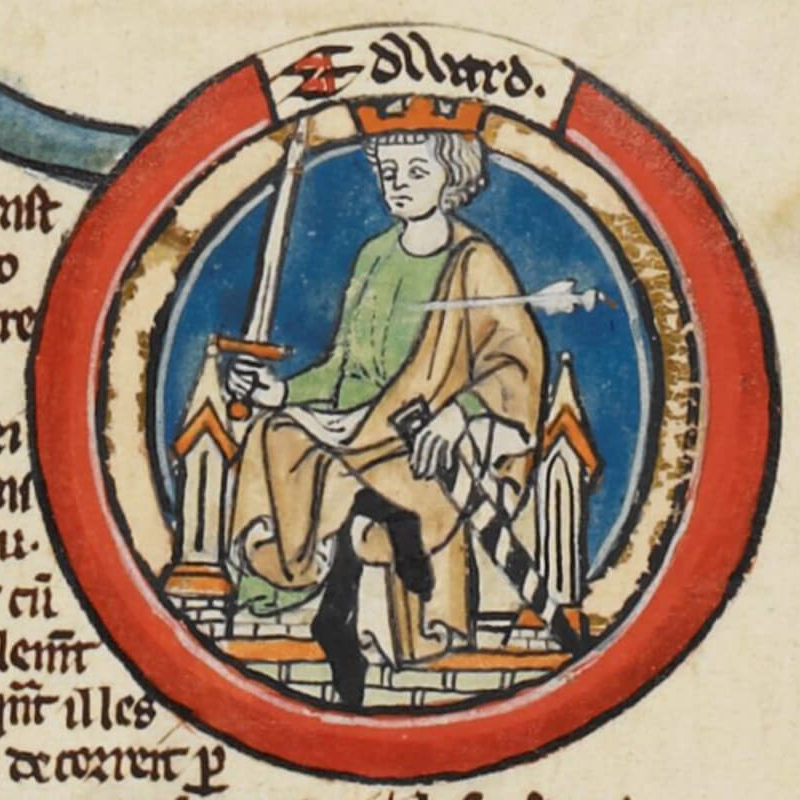
St Alban
(3rd or 4th century)
Alban, or Albanus (in Latin), was born at Verulamium (modern-day St Albans) in Roman Britain. He is considered to be the first British martyr, believed to have been executed for converting to Christianity during Roman rule sometime during the 3rd or 4th century. According to the medieval historian Bede, he served in the Roman army and was converted to Christianity by a fugitive priest whom he sheltered and with whom he exchanged clothes, so that he was martyred in the priest’s place. His tomb was venerated, and a church had been built on the site as early as 429. Later, the Abbey of St Albans was founded there, and around it grew the town of St Albans, named after him. Both his date of birth and date of death are unknown, but some disputed dates for his death are 209, 251, 254, and 304.
St Patrick
(Born c. 387 – Died c. 460)
Patrick, along with St Columba and St Brigid of Kildare, is one of the three patron saints of Ireland. One of the worlds most popular saints, Patrick wasn’t actually Irish, but he found his faith while being held as prisoner by a group of Irish raiders. Patrick was born in Roman Britain of a wealthy Romanised family. He was taken from Britain by Irish raiders and sold into slavery in Ireland at the age of 16, where he was enslaved by Irish pagans and druids. He turned to god while in captivity and managed to escape several years later and returned to Britain. But after having a dream in which he heard the “voice of the Irish” begging him to convert the people of Ireland to Christianity, he returned to Ireland where he preached the gospel for 40 years, converting many pagans and helped to convert the country into a stronghold of Christianity. He is believed to have died on 17th March, now popularly known as Saint Patrick’s Day, around the year 460.
St Brigid of Kildare
(Born c. 450 – Died c. 525)
Little is known of Brigid’s life but from legend, myth, and folklore. According to tradition, Brigid was the daughter of an Irish clan chief and an enslaved Christian woman, and was fostered in a druid’s household before becoming a consecrated virgin. She became an abbess who founded an important monastic community at Kildare in the 5th century, as well as several other convents of nuns. Some historians suggest that Brigid is a Christianisation of the Celtic goddess Brigid. She is revered as one of the three patron saints of Ireland, along with St Patrick and St Columba.
St David
(Born c. 500 – Died c. 589)
The small cathedral city of St Davids in Pembrokeshire, Wales, which is the smallest city in Britain, is the resting place of Saint David, Wales’s patron saint since the 12th century, which is named after him. According to legend, his mother, St Non, gave birth to him on a Pembrokeshire clifftop during a fierce storm. His birth date, however, is uncertain; suggestions range from 462 to 515. It is said that an angel foretold his birth to St Patrick 30 years before it happened. Non named her son Dewidd, or Dewi to the locals, but he was baptised as David. He was a Welsh Christian prelate who served as Bishop of Mynyw during the 6th century. He lived a simple life and practised asceticism, teaching his followers to refrain from eating meat and drinking beer. He was a renowned preacher, founding monastic settlements and churches in Wales, Brittany and south-west England. Though the exact date of his death isn’t certain, tradition holds that it was on 1st March, which is the date now marked as Saint David’s Day. The two most common years given for his death are 589 and 601. He was buried at the site of St Davids Cathedral, where his shrine was a popular place of pilgrimage throughout the Middle Ages.
St Columba
(Born 521 – Died 597)
Columba was an Irish abbot and missionary credited with having had a main role in the Christian conversion of the pagan Picts of Pictland, what is today Scotland, at the start of the Celtic Christian missions in the 6th century. He founded the important abbey on Iona in the Gaelic kingdom of Dalriada, which became a dominant religious and political institution in the region for centuries. He is a patron saint of Scotland and one of the three patron saints of Ireland, after St Patrick and St Brigid of Kildare. He is also the patron saint of the city of Derry, where he founded a monastic settlement in c. 540. Columba and his associates and successors spread the gospel more than any other contemporary group of religious pioneers in Britain. In Ireland he is commonly known as Colmcille, Columba being his Latin name.
St Augustine of Canterbury
(Born ? – Died 604)
Augustine was a Benedictine monk born in the early 6th century in Rome. Christianity had been present in England during Roman times, but with the arrival of the Anglo-Saxons, most of the country had once again reverted to paganism. Augustine was chosen by Pope Gregory I, also known as Gregory the Great, to lead a mission to convert the pagan Anglo-Saxons to the Christian faith, usually known as the Gregorian mission. In 597, the same year that Columba of Iona died, Augustine arrived in Kent from Rome and first converted the pagan Anglo-Saxon king Æthelberht, King of Kent. Augustine founded the Christian church in southern England by establishing one of medieval England’s most important abbeys, Canterbury. He became the first archbishop of Canterbury and the “Apostle to England”, and played a major role in kickstarting the country’s conversion back to Christianity.
St Aidan of Lindisfarne
(Born c. 590 – Died 651)
Known as the ‘Apostle of Northumbria’, Aidan was an Irish monk and missionary from the monastery on the island of Iona founded by St Columba, and is credited with converting the Anglo-Saxons to Christianity in Northumbria. Aidan settled on Lindisfarne (or Holy Island) off the coast of Northumbria where he founded his church, monastery, and a school for the training of ministers, among whom were Chad (first bishop of Lichfield), his brother Cedd (who converted the East Saxons), and Eata, abbot of Melrose. Under his direction and that of his successors, Lindisfarne flourished as a leading ecclesiastical centre until the Danish invasions began in 793. Serving as Lindisfarne’s first bishop, he travelled ceaselessly throughout the Northumbrian countryside, spreading the gospel to both the Anglo-Saxon nobility and the socially disenfranchised, including children and slaves. The Anglo-Saxon historian and theologian Bede praised Aidan for his learning, charity, and simplicity of life.
Oswald of Northumbria
(Born c. 604 – Died 641/642)
Oswald was an early Anglo-Saxon king, martyr and saint. Oswald fled with his brother Oswiu to the Gaelic Christian kingdom of Dalriada when their father, the King, was killed in battle. There, he spent the remainder of his youth and was converted to Christianity by Irish monks. At the head of a small army, possibly with the aid of allies from the north, the Scots and/or the Picts, Oswald returned to Northumbria, gained a victory in battle, reunited the kingdom, and became King of Northumbria from 633 until his death. Oswald introduced Celtic Christian missionaries to his kingdom and gained ascendancy over most of England. He was one of only a handful of Anglo-Saxon kings that gained the title of ‘Bretwalda‘, which was a term given to kings who had achieved overlordship of some or all of the other Anglo-Saxon kingdoms and rulers. After nine years of rule, in which he was the most powerful ruler in Britain, Oswald was killed in battle while fighting the forces of the pagan king Penda of Mercia, who then himself was later defeated by Oswald’s brother Oswiu. His death in battle against Penda the heathen king of Mercia was seen as a martyr’s death and he soon came to be regarded as a saint. Venerated as a martyr of the Northumbrian church, it was believed that his remains worked miracles.
St Cedd
(Born c. 620 – Died 664)
Born to a noble Northumbrian family, Cedd was an Anglo-Saxon monk, monastic founder, bishop, and missionary, who founded many churches and monasteries and spread Christianity throughout England in the 7th century. He was a significant participant in the Synod of Whitby, a meeting which resolved important differences within the Church in England. Cedd, along with his brother Chad, also a saint, were both educated at the great abbey of Lindisfarne (or Holy Island) under its founder, St Aidan. Cedd was an evangelist of the Middle Angles (Kingdom of Mercia) and East Saxons (Kingdom of Essex) in England, and was consecrated Bishop of Essex. Later, with the help of his brother Chad, he established the monastery of Laestingaeu, now Lastingham in North Yorkshire, and became its first abbot. Cedd fell ill with the plague at his monastery in Lastingham and died in 664, and his brother Chad succeeded him as abbot of Lastingham.
St Chad of Mercia
(Born c. 620s – Died 672)
Born to a noble Northumbrian family, Chad was an Anglo-Saxon monastic founder, abbot, missionary, and the first bishop of Lichfield, who is credited with the Christianisation of the Anglo-Saxon kingdom of Mercia. With his brother Cedd, also a saint, he was educated at the great abbey of Lindisfarne (or Holy Island) under its founder, St Aidan. Chad helped his brother Cedd to establish the monastery of Laestingaeu, now Lastingham in North Yorkshire. Upon Cedd’s death in 664, Chad succeeded him to become the second abbot of Laestingaeu. Shortly after, at the request of King Oswiu of Northumbria, Chad was consecrated bishop of Northumbria before being appointed bishop of Mercia, where he built a church and monastery at Lichfield to serve as the new seat of his diocese. Chad is also credited with founding monasteries at Lindsey and Barrow-upon-Humber. He is noted as having conducted his apostolate zealously, travelling much on foot. He died of plague in Lichfield in 672, and numerous miracles were reported as having occurred at his tomb.
St Eata of Hexham
(Born ? – Died 686)
A native of Northumbria, Eata’s date of birth is not known, but he was probably born in the reign of King Oswald of Northumbria. He was raised from an early age to be trained to be an abbot, and was one of the original twelve pupils of St Aidan at Lindisfarne, along with St Cedd and St Chad. Throughout his life he was abbot of Melrose, bishop of Bernicia, bishop of Lindisfrane, and bishop of Hexham. He was the first native of Northumbria to occupy the bishopric of Lindisfarne. Eata died of dysentery at Hexham in 686 and was buried in the Benedictine Abbey of Hexham in Northumbria. Like most of the early saints of the English Church, St Eata was canonised by general repute of sanctity among the faithful in the regions which he helped to Christianise. He was a gentle, peacful and saintly man, and greatly revered.
St Wilfrid
(Born c. 633 – Died 709/710)
Born a Northumbrian noble, Wilfrid was one of the greatest English saints, a monk and bishop who was outstanding in bringing about close relations between the Anglo-Saxon Church and the papacy. He entered religious life as a teenager and studied at both Lindisfarne and at Rome, where he devoted his life to establishing the observances of the Roman Church over those of the Celtic Church. Throughout his life he was made abbot of Ripon, bishop of Hexham, and bishop of York. Acting as spokesman for the Roman position, Wilfrid was instrumental at the Synod of Whitby where he won the argument for moving away from Celtic practices in favour of the more orderly Roman Church. Wilfrid remained for 45 tireless years a leader in the English Church, as bishop, missionary, abbot, church-builder and adviser to kings. When he died aged 75 or 76 years old, he left large sums of money to his monastic foundations and he was buried near the altar of his church in Ripon.
St Cuthbert
(Born c. 634 – Died 687)
Cuthbert of Lindisfarne was a medieval monk, bishop and hermit of the early Northumbrian church in the Celtic tradition. One of the most venerated English saints, Cuthbert evangelised the Anglo-Saxon kingdom of Northumbria and is regarded as the patron saint of Northumbria. He was the bishop of the great Benedictine abbey of Lindisfarne (or Holy Island) off the coast of Northumbria, and is said to have performed many healing miracles. Famous for his holiness, wisdom, gentle leadership, miracles, tact and patience, and for spreading Christianity in northern England, he is one of the most beloved saints in Northern England, with a cult centred on his tomb at Durham Cathedral.
Bede the Venerable
(Born 672/3 – Died 735)
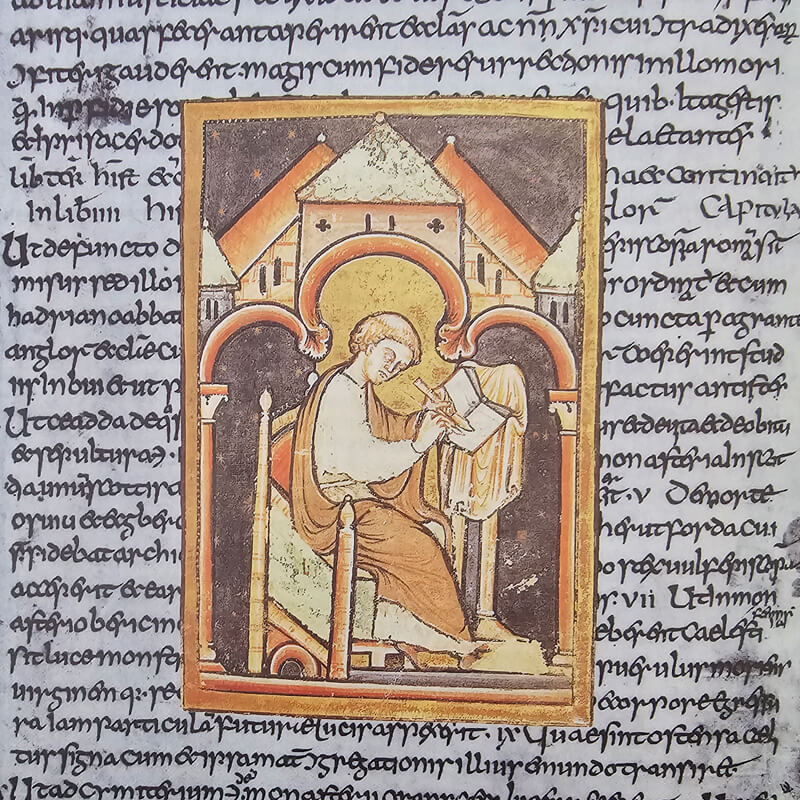
Bede was an Anglo-Saxon monk, author and scholar. Born in the kingdom of Northumbria, he is known as one of the greatest teachers and writers of the Early Middle Ages, and is widely regarded as one of the most important figures in early English Christianity and the greatest of all the Anglo-Saxon scholars. He was raised in a monastery from the age of seven and spent most of his life there and rarely left it. Bede wrote or translated over 40 books on practically every area of knowledge. He wrote the first martyrology (a chronicle about the lives of martyrs and saints), but his most famous work, Historia ecclesiastica gentis Anglorum (Ecclesiastical History of the English People), written in around 731/732, gained him the title “The Father of English History”. Bede died in his cell at the monastery in May 735 aged 61 or 62. He was declared Venerable by the Church in 836 and was canonised in 1899. He was named “Doctor of the Church” by Pope Leo XIII because of his work and piety. The influence of this humble early-medieval monk from Northumbria was felt throughout Europe and continues across the world today.
Guthlac of Crowland
(Born c. 674 – Died 714)
Guthlac was the son of Penwalh, a noble of the English kingdom of Mercia, and like any other Anglo-Saxon nobleman, he began his life as a warrior. As a young man, Guthlac fought in the army of King Æthelred of Mercia, son of King Penda of Mercia. He then became a monk at Repton Monastery in Derbyshire around the age of 24 where he lived a life of exceptional piety. Two years later, he took up the life of a hermit at Crowland in the Lincolnshire Fens. According to tradition, once he had settled into his new life, Guthlac was quickly set upon by demons with a series of temptations. Saint Bartholomew himself appeared to Guthlac and promised to come to his aid whenever he needed. The the help of Bartholomew, Guthlac remained unshaken, challenged his tormentors and successfully overcame them. A series of miracles were said to have been performed by Guthlac before and after his death. Guthlac became very ill, and his death is traditionally dated to 11th April 714. Guthlac was venerated as a prominent local saint, with churches being dedicated to him throughout the area around the Fens in the East Midlands and beyond, and subsequently became one of Anglo-Saxon England’s most important saints.
St Boniface
(Born c. 675 – Died 754)
Boniface was an Anglo-Saxon Benedictine monk and missionary who spread Christianity in mainland Europe and was martyred in Germany. He was a leading figure in the Anglo-Saxon mission to the Germanic parts of Francia during the 8th century. He organised significant foundations of the church in Germania and was made bishop of Mainz by Pope Gregory III. He was martyred in Frisia in 754, along with many others, and his remains were returned to Fulda in Germany, where they rest in a sarcophagus which remains a site of Christian pilgrimage. He is venerated as a saint in the Christian church and became the patron saint of Germania, known as the ‘Apostle to the Germans’.
St Kenelm
(Born c. 786 – Died 821)
Kenelm was a martyr and member of the Anglo-Saxon royal family of Mercia. He was the son of Coenwulf, King of Mercia, with close links to Winchcombe, where his body was interred. Legend says that the boy-king of Mercia was to succeed his father, but he was reputedly murdered by his ambitious elder sister and her lover so that she could reign as Queen. His body, after being concealed, was discovered by miraculous intervention, and transported by the monks of Winchcombe to Winchcombe Abbey where he was buried alongside his father. The earliest account of St Kenelm’s legend lies in a manuscript copy from the 12th century at Winchcombe Abbey. He was venerated throughout medieval England and mentioned in the Canterbury Tales.
St Swithin
(Born c. 800 – Died 862/863)
Swithin, or Swithun, was an Anglo-Saxon bishop of Winchester and subsequently patron saint of Winchester Cathedral. He served as counselor to Kings Ecgberht and Æthelwulf of the West Saxons. The shrine of St Swithin at Winchester was supposedly a site of numerous miracles in the Middle Ages.
St Dunstan
(Born c. 909 – Died 988)
Dunstan was an Anglo-Saxon bishop and Benedictine monk. He was successively Abbot of Glastonbury, Bishop of Worcester, Bishop of London, and Archbishop of Canterbury. He was also a chief adviser to several kings of Wessex. He was of noble birth and was educated by Irish monks. His work restored monastic life in England under the Benedictine rule and reformed the English Church. Dunstan was the most popular saint in England for nearly two centuries until he was overshadowed by Thomas Becket’s fame in the 12th century. Dunstan was canonised in 1029 for his piety, devotion to learning, and dedication to the church. He is buried in Canterbury Cathedral.
Æthelwold of Winchester
(Born 904/9 – Died 984)
Æthelwold was Bishop of Winchester from 963 until his death in 984 and was one of the leaders of the 10th-century monastic reform movement in Anglo-Saxon England. Monastic life had declined in England in the 9th century, partly because of the ravages caused by Viking attacks. Along with Dunstan, Abbot of Glastonbury and later Archbishop of Canterbury, and Oswald, Bishop of Worcester and Archbishop of York, they brought England into the movement for monastic reform under the Benedictine rule that had started in continental Europe earlier in the century. Æthelwold’s career started at Glastonbury which, under Dunstan, was the first of the English monasteries to be reformed according to the rule of St Benedict. He is recognised as a key figure in the reform movement and also made a major contribution to the revival of learning and the arts. When he died, a group of his former pupils venerated him and ensured his canonisation as St Æthelwold.
Oswald of Worcester
(Born c. 925 – Died 992)
Oswald was an Anglo-Saxon archbishop who was a leading figure in the 10th-century movement of monastic and feudalistic reforms. Oswald was of Danish ancestry, but brought up by his uncle, Oda, Archbishop of Canterbury, who sent him to France to the abbey of Fleury to become a monk. Oda was the son of a Danish Viking invader who had come to England in c. 865 in the ‘Great Heathen Army’ led by the sons of Ragnar Lothbrok, Ivar and Ubbe. When Oswald returned to England, he was consecrated as Bishop of Worcester by Archbishop Dunstan, and was later promoted to Archbishop of York. Together with Æthelwold, Oswald was a supporter and one of the leading promoters of Dunstan’s reforms of the church. Oswald died in 992 in the act of washing the feet of the poor at Worcester, and almost immediately after his death, miracles were reported at his funeral and at his tomb.
Edmund the Martyr
(Born 841 – Died 869)
Edmund was the king of the Anglo-Saxon kingdom of East Anglia from about 855 until his death in 869. He fought alongside King Alfred of Wessex (Alfred the Great) against the Great Heathen Army until his forces were defeated and he was captured by the Vikings. East Anglia was devastated by the Vikings, who destroyed any contemporary evidence of Edmund’s reign, and he was ordered to renounce his faith and share power with the pagan Vikings, but he refused. Historical sources say that Edmund was then bound to a tree, shot through by arrows and beheaded. In the early 10th century the remains of the martyr king were moved to Beodericsworth, where King Æthelstan founded a religious community to care for his shrine, which was said to have performed miracles and became a place of national pilgrimage. By 925 the fame of St Edmund had spread far and wide, and the name of the town where he was buried was changed to St Edmund’s Bury, and later to Bury St Edmunds. Edmund the Martyr became the first patron saint of England until the Plantagenet kings replaced him in the 14th century with Saint George, a foreigner. Recent attempts have been made to reinstate Edmund as patron saint of England as he was an Englishman, a martyred Anglo-Saxon king. Whereas St George was a 3rd-century Roman soldier born in modern-day Turkey, the patron saint of 16 other countries, and never even visited England.
Edward the Martyr
(Born c. 962 – Died 978)
Edward was King of the English from 975 until he was murdered in 978, less than three years into his reign. He was the eldest son of King Edgar the Peaceful, and older half-brother of Æthelred the Unready. Upon their father’s death, a faction sought to win the throne for the younger Æthelred, but Edward was quickly elected king aged just 13 years old with the help of Dunstan, Archbishop of Canterbury, and Oswald, Archbishop of York. Edward, expecting a welcome, was assassinated while visiting Æthelred at Corfe Castle in Dorset, and Æthelred subsequently succeeded to the throne. Who murdered Edward remains a mystery but it was most likely his half-brother’s supporters. Edward’s stepmother, Æthelred’s mother, may even have had a hand in the murder. Edward was a devout Christian. He was widely mourned and his death was blamed on “irreligious” enemies. His remains were said to produce miracles, and in 1001 he was honoured as Saint Edward the Martyr. His cult was even promoted by Cnut the Great.
Edward the Confessor
(Born c. 1003 – Died 1066)
Edward the Confessor was an Anglo-Saxon English king and saint. Considered the last king of the House of Wessex, he ruled from 1042 until his death in 1066. He was the son of Æthelred the Unready and Emma of Normandy. He succeeded Cnut the Great‘s son, and his own half-brother, Harthacnut. He was hailed throughout his life as a gentle, loyal and devoted king. He suffered for his faith by resisting the temptations of the world, and lived off the income of his own lands and reached out to the poor. Edward the Confessor was given his name because he was known for his deep piety and saintly life. The term ‘Confessor’ was used to describe someone who was believed to have lived a holy life but was not a martyr. He was the only king of England to be canonised by the pope.
St Wulfstan
(Born c. 1008 – Died 1095)
Wulfstan was an English Benedictine monk who served as Bishop of Worcester from 1062 to 1095, and was the last surviving pre-Conquest bishop. After the Norman conquest of England, Wulfstan was the only English-born bishop to retain his diocese for any significant amount of time; all others had been replaced or succeeded by Normans by 1075. Wulfstan co-founded the Great Malvern Priory, and undertook much large-scale rebuilding work, including Worcester Cathedral, Hereford Cathedral, Tewkesbury Abbey, and many other churches in the Worcester, Hereford and Gloucester areas. He ended the capture and sale of slaves at Bristol, helped compile Domesday Book, and he frequently served as adviser to King William II of England. Wulfstan died in 1095 whilst washing the feet of parishioners as was his custom. After his death, an altar was dedicated to him in Great Malvern Priory, next to those of Thomas Cantilupe and King Edward the Confessor. When Wulfstan died he was the only English-born bishop left in England, and the stories told about him claim he was respected by both Normans and English alike.
Thomas Becket
(Born 1120 – Died 1170)
Thomas Becket was Archbishop of Canterbury, the most important bishop in England. His career was marked by a long quarrel with Henry II that ended with Becket’s brutal murder in Canterbury Cathedral at the hands of four of Henry’s knights. Historians have long debated whether his murder was on the orders of the King or if it was a terrible misunderstanding. His death shocked medieval society and inspired a cult of followers, and he was made a saint and martyr in 1173.
Did you enjoy this post?
I hope you found this post useful. I put a great deal of time and effort in to building, maintaining and populating the website. If you like, you could say a small thank you by buying me a coffee. You don't have to, but it would be nice :)
Buy me a coffee
Stay up to Date
Follow me on my journey and get notified whenever a new post is published by following Kings & Castles on Facebook.
Follow MeExplore The Map
Discover the hundreds of castles, churches, monasteries, cathedrals and other historic locations that I've personally visited across England and Wales. Search by location, explore nearby sites and plan your next historical adventure.
Share: